Market Review
The markets continued their upward trajectory over the last quarter, with all asset classes achieving positive returns and with less volatility than we saw in the previous quarter (see chart below). Investors responded positively to the planned interest rate cut in September, more clarity on tariffs, and the passage of tax legislation in early July.
Of note, smaller company U.S. stocks outperformed large company stocks during the quarter, with U.S. small caps experiencing some of their best returns in recent years.
International stocks also had positive returns in the third quarter, with developed international equities lagging domestic stocks, but emerging markets outperforming. Both remained ahead of the U.S. for the year to date.
In the bond market, US Treasuries were up 2.0% for the quarter, with the U.S. aggregate bond index returning just over 6% year to date.
Tariffs
Market volatility due to tariffs subsided during the quarter, with the U.S. negotiating several trade deals, including with the European Union, the United Kingdom, and Japan. Nonetheless there remains some uncertainty on the final state of tariffs in the U.S. and their impact on the U.S. economy. Some key tariff-related dates in the fourth quarter:
• President Trump pushed out his deadline (again) for his decision on China tariffs until November 9th. Tariffs will remain at 30% at least until then, rather than increasing to the planned 145%.
• Starting October 14th, the U.S. will impose 10% tariffs on imported timber and lumber, and 25% tariffs on upholstered wooden furniture products and kitchen cabinets. These one-off tariffs are part of a pattern of cherry picking higher or lower tariffs for specific goods.
• In November, the U.S. Supreme Court will determine the validity of the Trump Administration’s approach to imposing tariffs by executive order.
Whether or not the Supreme Court finds that the Trump Administration has the authority to impose and negotiate tariffs without Congressional approval, it is still too soon to fully realize the impact of tariffs on the economy, prices of goods, and profit margins. As companies continue to operate under a new normal, we will begin to see the effects play out in the economy.
Interest Rates
After staying the course in July and August, the Federal Reserve cut interest rates by a quarter of a percentage point on September 17th. This was the first rate change since last December. Future rate cuts will be balanced by the Fed’s dual objectives of keeping both inflation and unemployment in check. Markets currently anticipate another rate cut in October, and then another in December.
Mortgage rates fell slightly during the quarter providing limited relief for homebuyers. The average rate on a standard, 30-year fixed mortgage drifted down to a low of 6.26% during the quarter and is currently expected to stay within the 6% to 7% range for the foreseeable future. Mortgage rates tend to move with yields on longer term securities, such as 10-year Treasuries. Such rates rise and fall based on expectations for the economy. Directional moves of short-term rates may inform those expectations, but they are not the only driver.
Risky Business
In August, President Trump signed an executive order that supports a path for the Department of Labor to give employers the fiduciary wiggle room to add private equity and other private assets to 401(k) plans and other workplace retirement plans.
The private equity industry, which is dealing with liquidity issues and poor performance is frothing at the mouth to get access to the $12 trillion+ pool of investable assets in workplace retirement plans. This can only be described as a horrible idea.
Private investments may be suitable for institutional investors with tens of millions of dollars to invest and with the accompanying risk profile that allows them to bear significant losses. Such investors have access to expert financial analysis and have negotiating leverage in private deals. Private investment is patently not appropriate for the average 401(k) holder who is unlikely to have enough financial acumen to understand the high fees, low liquidity and opaqueness of such investments.
Unfortunately, the large retirement plan providers will most likely end up offering private investments as options, simply to remain competitive. It will be up to the plan fiduciaries, who are financially liable when something goes wrong in a workplace plan, to be smart enough not to add these types of investments to their fund line-ups.
Closing Thoughts
There was an article in the Wall Street Journal in early September with the title “U.S. Stocks Are Now Pricier Than They Were in the Dot-Com Era.”1 The article references financial ratios such as the price-to-sales ratio and price-to-earnings ratio, which are at extreme highs in relation to the history of the S&P 500 Index.
Nvidia is the first public company to reach a market capitalization of $4 trillion, making it nearly 8% of the S&P 500 Index. Nine other companies in the S&P 500 have a market capitalization of over $1 trillion and investors are paying a premium for “AI” related stocks, expecting incredible future success which may or may not be achievable.
Even if we are in another technology-induced period of irrational exuberance, trying to time the market on the way out and on the way back in is a losing proposition. You already know that there is volatility in the market, and this is the cost of higher expected returns over time. Ensuring that your asset allocation matches your risk tolerance for market volatility is how best to manage the uncertainty of valuation fluctuations. The goal is to avoid excessive anxiety and panic behavior in the event of a market downturn. Milestone maintains your appropriate portfolio asset allocation, within certain thresholds, through periodic rebalancing to harvest some profits and redirect them to undervalued asset classes. This periodic rebalancing helps prevent your exposure to any one overvalued asset exceeding your risk tolerance.
1 https://www.wsj.com/finance/stocks/stock-market-valuation-highs-ac291e72
The following table summarizes the performance of major asset classes through 09/30/2025:
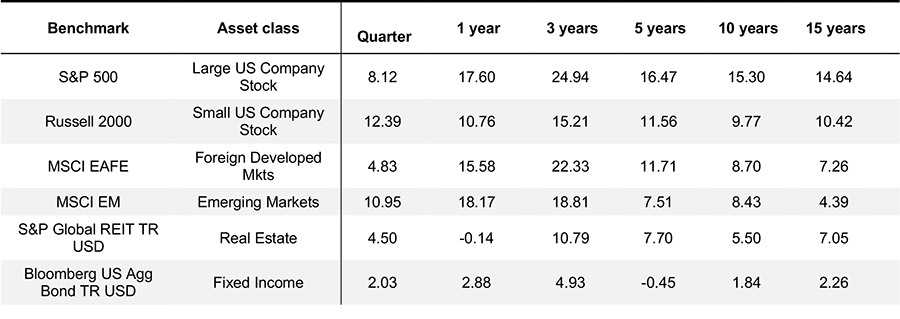
Note: Return data obtained from Dimensional Fund Advisors database. Returns include dividends and reinvestments.
Disclaimer:
This material is provided for educational and informational purposes only and is not investment, tax, legal, or financial advice. It does not consider any individual’s investment objectives, strategies, tax situation, or time horizon, and it is not an offer to sell or a solicitation to buy any security. Financial aid rules, tax laws, and school policies change frequently and vary by institution; figures cited are as of October 2026. Investing in a 529 plan involves risk, including the possible loss of principal. Before investing, review the plan’s offering documents for its investment objectives, risks, fees, and expenses, and consider whether your home state offers tax benefits only for its own plan. Please review your personal situation with your tax and/or financial advisor before acting.
Views expressed are subject to change based on market and other conditions. Any projections, market outlooks, estimates, or other forward-looking views are based on assumptions, are not indicative of future performance, and actual results may differ materially. Information is obtained from third-party sources believed to be accurate, but Milestone makes no representation as to its accuracy, completeness, or timeliness and accepts no liability for decisions based on it. Past performance is not indicative of future results. All investments involve risk, including the possible loss of principal.
Milestone Financial Planning, LLC (“Milestone”) is a fee-only financial planning firm and registered investment advisor headquartered in Bedford, NH. Registration does not imply a certain level of skill or training. Milestone works with clients on an ongoing, long-term basis, providing financial planning, tax planning, retirement planning, and investment management services. Fees are based on assets under management and may include a financial planning fee. Milestone receives no commissions or referral fees and, as a fiduciary, is required to act in clients’ best interests. Advisory services are offered only where Milestone and its representatives are properly licensed or exempt from licensure. More information, including fees and principal risks, is available in Milestone’s Form ADV Part 2A. For help with your investments or financial planning, contact one of our fee-only advisors.







Market Review
The markets continued their upward trajectory over the last quarter, with all asset classes achieving positive returns and with less volatility than we saw in the previous quarter (see chart below). Investors responded positively to the planned interest rate cut in September, more clarity on tariffs, and the passage of tax legislation in early July.
Of note, smaller company U.S. stocks outperformed large company stocks during the quarter, with U.S. small caps experiencing some of their best returns in recent years.
International stocks also had positive returns in the third quarter, with developed international equities lagging domestic stocks, but emerging markets outperforming. Both remained ahead of the U.S. for the year to date.
In the bond market, US Treasuries were up 2.0% for the quarter, with the U.S. aggregate bond index returning just over 6% year to date.
Tariffs
Market volatility due to tariffs subsided during the quarter, with the U.S. negotiating several trade deals, including with the European Union, the United Kingdom, and Japan. Nonetheless there remains some uncertainty on the final state of tariffs in the U.S. and their impact on the U.S. economy. Some key tariff-related dates in the fourth quarter:
• President Trump pushed out his deadline (again) for his decision on China tariffs until November 9th. Tariffs will remain at 30% at least until then, rather than increasing to the planned 145%.
• Starting October 14th, the U.S. will impose 10% tariffs on imported timber and lumber, and 25% tariffs on upholstered wooden furniture products and kitchen cabinets. These one-off tariffs are part of a pattern of cherry picking higher or lower tariffs for specific goods.
• In November, the U.S. Supreme Court will determine the validity of the Trump Administration’s approach to imposing tariffs by executive order.
Whether or not the Supreme Court finds that the Trump Administration has the authority to impose and negotiate tariffs without Congressional approval, it is still too soon to fully realize the impact of tariffs on the economy, prices of goods, and profit margins. As companies continue to operate under a new normal, we will begin to see the effects play out in the economy.
Interest Rates
After staying the course in July and August, the Federal Reserve cut interest rates by a quarter of a percentage point on September 17th. This was the first rate change since last December. Future rate cuts will be balanced by the Fed’s dual objectives of keeping both inflation and unemployment in check. Markets currently anticipate another rate cut in October, and then another in December.
Mortgage rates fell slightly during the quarter providing limited relief for homebuyers. The average rate on a standard, 30-year fixed mortgage drifted down to a low of 6.26% during the quarter and is currently expected to stay within the 6% to 7% range for the foreseeable future. Mortgage rates tend to move with yields on longer term securities, such as 10-year Treasuries. Such rates rise and fall based on expectations for the economy. Directional moves of short-term rates may inform those expectations, but they are not the only driver.
Risky Business
In August, President Trump signed an executive order that supports a path for the Department of Labor to give employers the fiduciary wiggle room to add private equity and other private assets to 401(k) plans and other workplace retirement plans.
The private equity industry, which is dealing with liquidity issues and poor performance is frothing at the mouth to get access to the $12 trillion+ pool of investable assets in workplace retirement plans. This can only be described as a horrible idea.
Private investments may be suitable for institutional investors with tens of millions of dollars to invest and with the accompanying risk profile that allows them to bear significant losses. Such investors have access to expert financial analysis and have negotiating leverage in private deals. Private investment is patently not appropriate for the average 401(k) holder who is unlikely to have enough financial acumen to understand the high fees, low liquidity and opaqueness of such investments.
Unfortunately, the large retirement plan providers will most likely end up offering private investments as options, simply to remain competitive. It will be up to the plan fiduciaries, who are financially liable when something goes wrong in a workplace plan, to be smart enough not to add these types of investments to their fund line-ups.
Closing Thoughts
There was an article in the Wall Street Journal in early September with the title “U.S. Stocks Are Now Pricier Than They Were in the Dot-Com Era.”1 The article references financial ratios such as the price-to-sales ratio and price-to-earnings ratio, which are at extreme highs in relation to the history of the S&P 500 Index.
Nvidia is the first public company to reach a market capitalization of $4 trillion, making it nearly 8% of the S&P 500 Index. Nine other companies in the S&P 500 have a market capitalization of over $1 trillion and investors are paying a premium for “AI” related stocks, expecting incredible future success which may or may not be achievable.
Even if we are in another technology-induced period of irrational exuberance, trying to time the market on the way out and on the way back in is a losing proposition. You already know that there is volatility in the market, and this is the cost of higher expected returns over time. Ensuring that your asset allocation matches your risk tolerance for market volatility is how best to manage the uncertainty of valuation fluctuations. The goal is to avoid excessive anxiety and panic behavior in the event of a market downturn. Milestone maintains your appropriate portfolio asset allocation, within certain thresholds, through periodic rebalancing to harvest some profits and redirect them to undervalued asset classes. This periodic rebalancing helps prevent your exposure to any one overvalued asset exceeding your risk tolerance.
1 https://www.wsj.com/finance/stocks/stock-market-valuation-highs-ac291e72
The following table summarizes the performance of major asset classes through 09/30/2025:
Note: Return data obtained from Dimensional Fund Advisors database. Returns include dividends and reinvestments.
Disclaimer:
This material is provided for educational and informational purposes only and is not investment, tax, legal, or financial advice. It does not consider any individual’s investment objectives, strategies, tax situation, or time horizon, and it is not an offer to sell or a solicitation to buy any security. Financial aid rules, tax laws, and school policies change frequently and vary by institution; figures cited are as of October 2026. Investing in a 529 plan involves risk, including the possible loss of principal. Before investing, review the plan’s offering documents for its investment objectives, risks, fees, and expenses, and consider whether your home state offers tax benefits only for its own plan. Please review your personal situation with your tax and/or financial advisor before acting.
Views expressed are subject to change based on market and other conditions. Any projections, market outlooks, estimates, or other forward-looking views are based on assumptions, are not indicative of future performance, and actual results may differ materially. Information is obtained from third-party sources believed to be accurate, but Milestone makes no representation as to its accuracy, completeness, or timeliness and accepts no liability for decisions based on it. Past performance is not indicative of future results. All investments involve risk, including the possible loss of principal.
Milestone Financial Planning, LLC (“Milestone”) is a fee-only financial planning firm and registered investment advisor headquartered in Bedford, NH. Registration does not imply a certain level of skill or training. Milestone works with clients on an ongoing, long-term basis, providing financial planning, tax planning, retirement planning, and investment management services. Fees are based on assets under management and may include a financial planning fee. Milestone receives no commissions or referral fees and, as a fiduciary, is required to act in clients’ best interests. Advisory services are offered only where Milestone and its representatives are properly licensed or exempt from licensure. More information, including fees and principal risks, is available in Milestone’s Form ADV Part 2A. For help with your investments or financial planning, contact one of our fee-only advisors.
Share:
Sign up below to receive blog and event updates.
Speak with an Advisor
Related articles
January 2026 Market Commentary
November 2025 Market Commentary
August 2025 Market Commentary