Market Review
After a chaotic year filled with tariff wars, market gyrations and the longest government shutdown in history, the U.S. markets have, once again, proved more resilient than many feared during the year. It would be a welcome change to experience less volatility in 2026, but with the Supreme Court ruling on the legitimacy of President Trump’s tariffs expected in January or February, rotation of the Federal Reserve chairman in May, and mid-term elections in the fall, we won’t count on it.
Despite sputtering towards the new year, 2025 was a great year for all segments of the investing universe (at least the ones we use in Milestone client portfolios).
Does anyone remember when fears about DeepSeek sent Nvidia’s stock tumbling 17% in one day last January? What about Liberation Day when the S&P 500 entered a bear market on April 7 when it was down 21.4% from its peak on February 19 (on an intra-day basis)?
Investors that held their ground during the year despite ongoing volatility were rewarded.
International vs. the U.S.
International stocks were the place to be in 2025. The MSCI All-Country World index, tracking large-capitalization stocks across developed (including the U.S.) and emerging markets, rose more than 20% last year. The difference between the S&P 500 (~17%) and the MSCI All Country World Ex-US (~29%) is the widest margin since the global financial crisis in 2009.
Fixed Income
The U.S. Aggregate Bond index was up over 7% for the year through a combination of interest payments (yield) and capital appreciation from falling interest rates. Yield should persist in 2026 with interest rates for investment grade bonds likely to stay close to where they are entering the year.
Tariffs
We will (hopefully) get more clarity on the end state of tariffs in 2026. The effective U.S. global tariff rate started the year under 3%, skyrocketed to 28% on Liberation Day and ended the year around 14%.1
Threats of additional hikes on various countries persist and exceptions for specific products continue to add up to more than the value of imports that are actually subject to tariffs. Clarity on the whole tariff regime could be had in the coming months with the Supreme Court ruling on the legality of the initial justification for the tariffs.
Interest Rates
For the third and final time in 2025, the Federal Reserve lowered interest rates by a quarter of a percentage point in early December. The target range for the federal funds rate now sits at 3.50% to 3.75%.
The minutes from December’s meeting indicated that some of the voting members were reluctant to support more cuts in the near future, a sign that another cut in January is not a certainty.2 Inflation will need to continue to moderate towards the long-term, 2% inflation rate.
President Trump is also expected to name a new Federal Reserve chairman in January to succeed Jerome Powell after his term ends in May. President Trump has indicated that he will pick a Fed chair who he views as committed to lower interest rates.
Consumer Confidence
Market performance was aided by strong third quarter Gross Domestic Product (GDP) data which exceeded the consensus forecast by 1% at an annualized rate of 4.3%.3 The data seemed to support the overall strength of the economy but did not align with other data showing continued negative consumer sentiment.
Consumer confidence declined in November for the fourth consecutive as measured by the University of Michigan consumer sentiment index, weighed down by ongoing concerns about the effects of tariffs and higher prices.4 Sentiment was up in December but it’s hard to envision it improving much in the short term.
The US Department of Education announced it will begin garnishing wages of defaulted student loan borrowers in January. As of November 2025, 5.5 million borrowers had defaulted on student loans with another 6.4 million nearing default.5
Now that the enhanced premium tax credits have officially expired, higher health insurance premiums are going to stress individuals and families who have depended on the enhanced credits to afford their health insurance premiums.
These are two major headwinds set to take a bite of individuals and family’s ability to make ends meet.
AI Deflation?
In November, there was a short-lived AI related company pullback in the U.S. stock market as investors became weary of overstretched valuations and profitability concerns of AI tech giants. These concerns will likely reappear in 2026. One measure of valuation, the S&P 500 cyclically adjusted price-to-earnings (CAPE) ratio is currently at 40 and the only time it has been higher was just prior to the dotcom bubble bursting in the early 2000’s.6
A company that remembers that bubble bursting, Cisco Systems, which became the world’s most valuable company at its peak in March 2000, finally reached its previous high stock price in December, 25 years later.
The difference today is that AI tech companies have real earnings and although they are dumping massive amounts of money into infrastructure to support future growth and current estimates of their value may turn out to be too optimistic, they have real and growing revenue.
What’s Ahead in 2026?
Will markets continue to go up? We hope so but no one can predict the future.
In the meantime, for anyone interested in getting a humanoid robot to knock things over in their house and fall headfirst down the stairs, 2026 might be the year they become available. For $200 you can put a deposit down for the future opportunity to buy a $20,000 NEO “Home Robot”.6
The following table summarizes the performance of major asset classes through 09/30/2025:
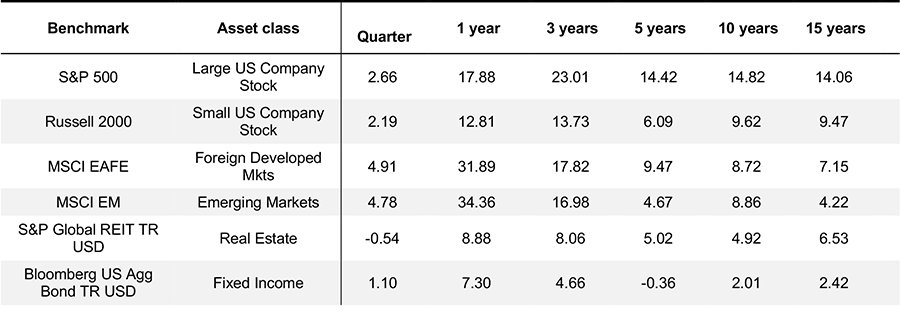
Note: Return data obtained from Dimensional Fund Advisors database. Returns include dividends and reinvestments.
Disclaimer:
This material is provided for educational and informational purposes only and is not investment, tax, legal, or financial advice. It does not consider any individual’s investment objectives, strategies, tax situation, or time horizon, and it is not an offer to sell or a solicitation to buy any security. Financial aid rules, tax laws, and school policies change frequently and vary by institution; figures cited are as of October 2026. Investing in a 529 plan involves risk, including the possible loss of principal. Before investing, review the plan’s offering documents for its investment objectives, risks, fees, and expenses, and consider whether your home state offers tax benefits only for its own plan. Please review your personal situation with your tax and/or financial advisor before acting.
Views expressed are subject to change based on market and other conditions. Any projections, market outlooks, estimates, or other forward-looking views are based on assumptions, are not indicative of future performance, and actual results may differ materially. Information is obtained from third-party sources believed to be accurate, but Milestone makes no representation as to its accuracy, completeness, or timeliness and accepts no liability for decisions based on it. Past performance is not indicative of future results. All investments involve risk, including the possible loss of principal.
Milestone Financial Planning, LLC (“Milestone”) is a fee-only financial planning firm and registered investment advisor headquartered in Bedford, NH. Registration does not imply a certain level of skill or training. Milestone works with clients on an ongoing, long-term basis, providing financial planning, tax planning, retirement planning, and investment management services. Fees are based on assets under management and may include a financial planning fee. Milestone receives no commissions or referral fees and, as a fiduciary, is required to act in clients’ best interests. Advisory services are offered only where Milestone and its representatives are properly licensed or exempt from licensure. More information, including fees and principal risks, is available in Milestone’s Form ADV Part 2A. For help with your investments or financial planning, contact one of our fee-only advisors.







Market Review
After a chaotic year filled with tariff wars, market gyrations and the longest government shutdown in history, the U.S. markets have, once again, proved more resilient than many feared during the year. It would be a welcome change to experience less volatility in 2026, but with the Supreme Court ruling on the legitimacy of President Trump’s tariffs expected in January or February, rotation of the Federal Reserve chairman in May, and mid-term elections in the fall, we won’t count on it.
Despite sputtering towards the new year, 2025 was a great year for all segments of the investing universe (at least the ones we use in Milestone client portfolios).
Does anyone remember when fears about DeepSeek sent Nvidia’s stock tumbling 17% in one day last January? What about Liberation Day when the S&P 500 entered a bear market on April 7 when it was down 21.4% from its peak on February 19 (on an intra-day basis)?
Investors that held their ground during the year despite ongoing volatility were rewarded.
International vs. the U.S.
International stocks were the place to be in 2025. The MSCI All-Country World index, tracking large-capitalization stocks across developed (including the U.S.) and emerging markets, rose more than 20% last year. The difference between the S&P 500 (~17%) and the MSCI All Country World Ex-US (~29%) is the widest margin since the global financial crisis in 2009.
Fixed Income
The U.S. Aggregate Bond index was up over 7% for the year through a combination of interest payments (yield) and capital appreciation from falling interest rates. Yield should persist in 2026 with interest rates for investment grade bonds likely to stay close to where they are entering the year.
Tariffs
We will (hopefully) get more clarity on the end state of tariffs in 2026. The effective U.S. global tariff rate started the year under 3%, skyrocketed to 28% on Liberation Day and ended the year around 14%.1
Threats of additional hikes on various countries persist and exceptions for specific products continue to add up to more than the value of imports that are actually subject to tariffs. Clarity on the whole tariff regime could be had in the coming months with the Supreme Court ruling on the legality of the initial justification for the tariffs.
Interest Rates
For the third and final time in 2025, the Federal Reserve lowered interest rates by a quarter of a percentage point in early December. The target range for the federal funds rate now sits at 3.50% to 3.75%.
The minutes from December’s meeting indicated that some of the voting members were reluctant to support more cuts in the near future, a sign that another cut in January is not a certainty.2 Inflation will need to continue to moderate towards the long-term, 2% inflation rate.
President Trump is also expected to name a new Federal Reserve chairman in January to succeed Jerome Powell after his term ends in May. President Trump has indicated that he will pick a Fed chair who he views as committed to lower interest rates.
Consumer Confidence
Market performance was aided by strong third quarter Gross Domestic Product (GDP) data which exceeded the consensus forecast by 1% at an annualized rate of 4.3%.3 The data seemed to support the overall strength of the economy but did not align with other data showing continued negative consumer sentiment.
Consumer confidence declined in November for the fourth consecutive as measured by the University of Michigan consumer sentiment index, weighed down by ongoing concerns about the effects of tariffs and higher prices.4 Sentiment was up in December but it’s hard to envision it improving much in the short term.
The US Department of Education announced it will begin garnishing wages of defaulted student loan borrowers in January. As of November 2025, 5.5 million borrowers had defaulted on student loans with another 6.4 million nearing default.5
Now that the enhanced premium tax credits have officially expired, higher health insurance premiums are going to stress individuals and families who have depended on the enhanced credits to afford their health insurance premiums.
These are two major headwinds set to take a bite of individuals and family’s ability to make ends meet.
AI Deflation?
In November, there was a short-lived AI related company pullback in the U.S. stock market as investors became weary of overstretched valuations and profitability concerns of AI tech giants. These concerns will likely reappear in 2026. One measure of valuation, the S&P 500 cyclically adjusted price-to-earnings (CAPE) ratio is currently at 40 and the only time it has been higher was just prior to the dotcom bubble bursting in the early 2000’s.6
A company that remembers that bubble bursting, Cisco Systems, which became the world’s most valuable company at its peak in March 2000, finally reached its previous high stock price in December, 25 years later.
The difference today is that AI tech companies have real earnings and although they are dumping massive amounts of money into infrastructure to support future growth and current estimates of their value may turn out to be too optimistic, they have real and growing revenue.
What’s Ahead in 2026?
Will markets continue to go up? We hope so but no one can predict the future.
In the meantime, for anyone interested in getting a humanoid robot to knock things over in their house and fall headfirst down the stairs, 2026 might be the year they become available. For $200 you can put a deposit down for the future opportunity to buy a $20,000 NEO “Home Robot”.6
The following table summarizes the performance of major asset classes through 09/30/2025:
Note: Return data obtained from Dimensional Fund Advisors database. Returns include dividends and reinvestments.
1 https://budgetlab.yale.edu/research/state-us-tariffs-november-17-2025
2 https://www.federalreserve.gov/monetarypolicy/files/fomcminutes20251210.pdf
3 https://www.sca.isr.umich.edu/
4 https://www.npr.org/2025/12/23/nx-s1-5653312/student-loans-default-education-department
5 https://shillerdata.com/
6 https://www.1x.tech/
Disclaimer:
This material is provided for educational and informational purposes only and is not investment, tax, legal, or financial advice. It does not consider any individual’s investment objectives, strategies, tax situation, or time horizon, and it is not an offer to sell or a solicitation to buy any security. Financial aid rules, tax laws, and school policies change frequently and vary by institution; figures cited are as of October 2026. Investing in a 529 plan involves risk, including the possible loss of principal. Before investing, review the plan’s offering documents for its investment objectives, risks, fees, and expenses, and consider whether your home state offers tax benefits only for its own plan. Please review your personal situation with your tax and/or financial advisor before acting.
Views expressed are subject to change based on market and other conditions. Any projections, market outlooks, estimates, or other forward-looking views are based on assumptions, are not indicative of future performance, and actual results may differ materially. Information is obtained from third-party sources believed to be accurate, but Milestone makes no representation as to its accuracy, completeness, or timeliness and accepts no liability for decisions based on it. Past performance is not indicative of future results. All investments involve risk, including the possible loss of principal.
Milestone Financial Planning, LLC (“Milestone”) is a fee-only financial planning firm and registered investment advisor headquartered in Bedford, NH. Registration does not imply a certain level of skill or training. Milestone works with clients on an ongoing, long-term basis, providing financial planning, tax planning, retirement planning, and investment management services. Fees are based on assets under management and may include a financial planning fee. Milestone receives no commissions or referral fees and, as a fiduciary, is required to act in clients’ best interests. Advisory services are offered only where Milestone and its representatives are properly licensed or exempt from licensure. More information, including fees and principal risks, is available in Milestone’s Form ADV Part 2A. For help with your investments or financial planning, contact one of our fee-only advisors.
Share:
Sign up below to receive blog and event updates.
Speak with an Advisor
Related articles
November 2025 Market Commentary
October 2025 Market Commentary
August 2025 Market Commentary