Market Review
Global equity markets rebounded strongly in early April, after President Trump announced a two-week cease fire with Iran. The two-week ceasefire has been extended through early May, although both sides continue to accuse the other of repeated violations. Military tensions continue to run high, as the U.S. has imposed a blockade on Iranian ports, and Iran threatens traffic through the Strait of Hormuz, a crucial shipping lane. As of this writing, equity markets seem to have shrugged off the current stalemate and energy crisis.
The S&P 500 gained 10.49% in April and 5.70% year-to-date. Clearly, the April rally salvaged a difficult start to the year for this index, which is heavily weighted in tech and AI stocks. In the face of challenges from the war with Iran, Energy led as the top-performing sector year-to-date for 2026. Other leading sectors included Materials and Industrials, as the AI trade seemed to broaden into other industries.
Despite emerging markets being traditionally susceptible to global energy shocks, the MSCI Emerging Markets index was up 14.73% in April and 18.11% year-to-date. This follows strong performance in 2025 when the index rose about 34%. South Korea and Tawain, home to key suppliers of the AI build-out in the U.S. and around the world, drove the high returns in this index. Other contributors included Brazil and Peru.
Interestingly, China’s contribution to the Emerging Market’s index through 4/30/2026 was a significant detractor (-7.18%). Several years ago, Milestone’s Investment Committee made the decision to utilize an emerging markets fund excluding China. That decision has been a net positive to Milestone client portfolios, as China has struggled with an ongoing real estate sector downturn, which in turn lead to decreased household confidence and reduced consumer spending. Continued political and regulatory uncertainty and an aging population also contribute to China’s headwinds.
Bond returns generally continued to stay relatively flat to slightly higher for another month. The Fed has held interest rates steady at its three meetings so far in 2026, adopting a wait-and-see approach between conflicting sticky inflation and pressure to reduce rates.
It’s hard to reconcile higher prices from inflation, low consumer confidence and pain at the pump with record stock indices, but that seems to be how markets are reacting so far. AI can’t continue to pull the cart if the Hormuz bottleneck isn’t resolved soon. Let’s hope in the next month that progress is made towards breaking the stalemate.
Gas Prices
The National Average Gas Prices index maintained by AAA showed gas prices are the highest they’ve been in four years, since late July 2022. The average price on April 30th was $1.41 higher than nine weeks earlier, right before the Iran war started. Energy Department data shows that this is the highest 9-week price surge since at least the early 1990s.1
Interest Rates
Before the conflict in Iran started, interest-rate expectations favored at least two rates cuts by the Fed in 2026. Now, thanks in part to the uptick in energy prices, the consensus is moving to neutral through the end of 2026, with an outside chance of a rate hike. The March jobs report suggested that the labor market remains relatively healthy. Job growth beat expectations and the unemployment rate dropped slightly to 4.3 percent, providing even less incentive to drop rates in the near term.2
As expected, at the meeting of the Federal Reserve on April 28th-29th, the Fed kept rates in place. Notably three Fed Governors dissented from that decision on principle, arguing that they wanted the Fed to indicate that its next interest-rate move could be either a cut or a hike.3
Europe may be approaching rate hikes sooner. Traders are pricing in three quarter-point increases from the European Central Bank for the remainder of 2026, while the Bank of England is expected to impose two to three increases before year end.
Fed Transition
Kevin Warsh’s nomination as the next chair of the Federal Reserve was approved by the Senate banking committee in late April, all but ensuring he will officially replace Jerome Powell later this month. At his final news conference last week, Jerome Powell said that he will stay on as a voting member of the Federal Reserve Board of Governors, for a time to be determined, so he can see through any investigation of the Fed by the U.S. Justice Department. He said that he plans “to keep a low profile as governor.”4
Trump IRAs
In addition to the new Section 530A Trump Accounts designed to jumpstart long-term savings for children, certain eligible adults in the U.S. will have the ability (starting in 2027) to open Trump IRAs.5 Designed to help people who don’t have access to 401(k) or other employer sponsored retirement plans, TrumpIRAs.gov will be a sort of clearing house for financial institutions to offer IRAs with low fees, simple investment options, and no minimum contribution or balances. The accounts will also be able to accept Federal Saver’s Match contributions of up to $1,000.
The New “Investing” Addiction
Remember the “meme stock” craze of the Covid era? Now there’s a new way for people to lose money in the form of online “prediction markets” platforms, the largest of which are Polymarket and Kalshi. Anyone with an account can “trade” on all sorts of things like sports events, the weather, elections, Federal Reserve decisions, word mentions, and basically anything else with an outcome. The platforms are designed to let individuals “trade the future” and trading volume on both platforms increased to $24.2 billion in April, up from $1.8 billion a year earlier. A Wall Street Journal analysis found that 67% of the profits on Polymarket went to just 0.1% of the accounts. In other words, the average user is losing their shirt while professional traders with expensive technology are netting all the spoils.6
Even worse, insiders are using knowledge to make money. The most prolific example is that of a U.S. soldier who was arrested for allegedly betting on the timing of the capture of Nicolas Maduro in Venezuela, an action that he planned and in which he participated.7
Worse still, there are instances of completely inappropriate prediction markets. In early April, Polymarket had people betting whether American F-15 fighter jet pilots would be rescued in Iran after being shot down.
These “markets” are creating a perverse incentive for people in positions of power, whether that be military, government, or civil society, to encourage or advantage policies or actions that favor an outcome on which they’ve placed wagers.
One could reasonably ask if there is any positive benefit from these platforms. Fortunately, there is a rising tide of governmental entities, financial institutions and private companies starting to ban their employees from engaging in bets on these sites. On May 4th, the U.S. Senate banned senators and their staff from using the platforms, following decisions by the states of New York and Maryland banning all state employees from using them. Let’s hope governments and companies act quickly to prohibit expansion of this practice.
The following table summarizes the performance of major asset classes through 04/30/2026:
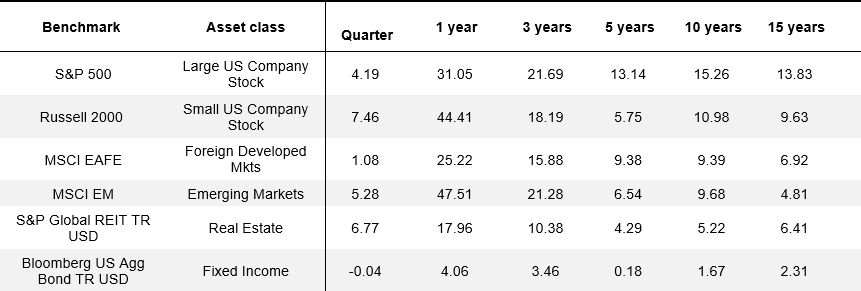
Note: Return data obtained from Dimensional Fund Advisors database. Returns include dividends and reinvestments.
Disclaimer:
This material is provided for educational and informational purposes only and is not investment, tax, legal, or financial advice. It does not consider any individual’s investment objectives, strategies, tax situation, or time horizon, and it is not an offer to sell or a solicitation to buy any security. Financial aid rules, tax laws, and school policies change frequently and vary by institution; figures cited are as of October 2026. Investing in a 529 plan involves risk, including the possible loss of principal. Before investing, review the plan’s offering documents for its investment objectives, risks, fees, and expenses, and consider whether your home state offers tax benefits only for its own plan. Please review your personal situation with your tax and/or financial advisor before acting.
Views expressed are subject to change based on market and other conditions. Any projections, market outlooks, estimates, or other forward-looking views are based on assumptions, are not indicative of future performance, and actual results may differ materially. Information is obtained from third-party sources believed to be accurate, but Milestone makes no representation as to its accuracy, completeness, or timeliness and accepts no liability for decisions based on it. Past performance is not indicative of future results. All investments involve risk, including the possible loss of principal.
Milestone Financial Planning, LLC (“Milestone”) is a fee-only financial planning firm and registered investment advisor headquartered in Bedford, NH. Registration does not imply a certain level of skill or training. Milestone works with clients on an ongoing, long-term basis, providing financial planning, tax planning, retirement planning, and investment management services. Fees are based on assets under management and may include a financial planning fee. Milestone receives no commissions or referral fees and, as a fiduciary, is required to act in clients’ best interests. Advisory services are offered only where Milestone and its representatives are properly licensed or exempt from licensure. More information, including fees and principal risks, is available in Milestone’s Form ADV Part 2A. For help with your investments or financial planning, contact one of our fee-only advisors.







Market Review
Global equity markets rebounded strongly in early April, after President Trump announced a two-week cease fire with Iran. The two-week ceasefire has been extended through early May, although both sides continue to accuse the other of repeated violations. Military tensions continue to run high, as the U.S. has imposed a blockade on Iranian ports, and Iran threatens traffic through the Strait of Hormuz, a crucial shipping lane. As of this writing, equity markets seem to have shrugged off the current stalemate and energy crisis.
The S&P 500 gained 10.49% in April and 5.70% year-to-date. Clearly, the April rally salvaged a difficult start to the year for this index, which is heavily weighted in tech and AI stocks. In the face of challenges from the war with Iran, Energy led as the top-performing sector year-to-date for 2026. Other leading sectors included Materials and Industrials, as the AI trade seemed to broaden into other industries.
Despite emerging markets being traditionally susceptible to global energy shocks, the MSCI Emerging Markets index was up 14.73% in April and 18.11% year-to-date. This follows strong performance in 2025 when the index rose about 34%. South Korea and Tawain, home to key suppliers of the AI build-out in the U.S. and around the world, drove the high returns in this index. Other contributors included Brazil and Peru.
Interestingly, China’s contribution to the Emerging Market’s index through 4/30/2026 was a significant detractor (-7.18%). Several years ago, Milestone’s Investment Committee made the decision to utilize an emerging markets fund excluding China. That decision has been a net positive to Milestone client portfolios, as China has struggled with an ongoing real estate sector downturn, which in turn lead to decreased household confidence and reduced consumer spending. Continued political and regulatory uncertainty and an aging population also contribute to China’s headwinds.
Bond returns generally continued to stay relatively flat to slightly higher for another month. The Fed has held interest rates steady at its three meetings so far in 2026, adopting a wait-and-see approach between conflicting sticky inflation and pressure to reduce rates.
It’s hard to reconcile higher prices from inflation, low consumer confidence and pain at the pump with record stock indices, but that seems to be how markets are reacting so far. AI can’t continue to pull the cart if the Hormuz bottleneck isn’t resolved soon. Let’s hope in the next month that progress is made towards breaking the stalemate.
Gas Prices
The National Average Gas Prices index maintained by AAA showed gas prices are the highest they’ve been in four years, since late July 2022. The average price on April 30th was $1.41 higher than nine weeks earlier, right before the Iran war started. Energy Department data shows that this is the highest 9-week price surge since at least the early 1990s.1
Interest Rates
Before the conflict in Iran started, interest-rate expectations favored at least two rates cuts by the Fed in 2026. Now, thanks in part to the uptick in energy prices, the consensus is moving to neutral through the end of 2026, with an outside chance of a rate hike. The March jobs report suggested that the labor market remains relatively healthy. Job growth beat expectations and the unemployment rate dropped slightly to 4.3 percent, providing even less incentive to drop rates in the near term.2
As expected, at the meeting of the Federal Reserve on April 28th-29th, the Fed kept rates in place. Notably three Fed Governors dissented from that decision on principle, arguing that they wanted the Fed to indicate that its next interest-rate move could be either a cut or a hike.3
Europe may be approaching rate hikes sooner. Traders are pricing in three quarter-point increases from the European Central Bank for the remainder of 2026, while the Bank of England is expected to impose two to three increases before year end.
Fed Transition
Kevin Warsh’s nomination as the next chair of the Federal Reserve was approved by the Senate banking committee in late April, all but ensuring he will officially replace Jerome Powell later this month. At his final news conference last week, Jerome Powell said that he will stay on as a voting member of the Federal Reserve Board of Governors, for a time to be determined, so he can see through any investigation of the Fed by the U.S. Justice Department. He said that he plans “to keep a low profile as governor.”4
Trump IRAs
In addition to the new Section 530A Trump Accounts designed to jumpstart long-term savings for children, certain eligible adults in the U.S. will have the ability (starting in 2027) to open Trump IRAs.5 Designed to help people who don’t have access to 401(k) or other employer sponsored retirement plans, TrumpIRAs.gov will be a sort of clearing house for financial institutions to offer IRAs with low fees, simple investment options, and no minimum contribution or balances. The accounts will also be able to accept Federal Saver’s Match contributions of up to $1,000.
The New “Investing” Addiction
Remember the “meme stock” craze of the Covid era? Now there’s a new way for people to lose money in the form of online “prediction markets” platforms, the largest of which are Polymarket and Kalshi. Anyone with an account can “trade” on all sorts of things like sports events, the weather, elections, Federal Reserve decisions, word mentions, and basically anything else with an outcome. The platforms are designed to let individuals “trade the future” and trading volume on both platforms increased to $24.2 billion in April, up from $1.8 billion a year earlier. A Wall Street Journal analysis found that 67% of the profits on Polymarket went to just 0.1% of the accounts. In other words, the average user is losing their shirt while professional traders with expensive technology are netting all the spoils.6
Even worse, insiders are using knowledge to make money. The most prolific example is that of a U.S. soldier who was arrested for allegedly betting on the timing of the capture of Nicolas Maduro in Venezuela, an action that he planned and in which he participated.7
Worse still, there are instances of completely inappropriate prediction markets. In early April, Polymarket had people betting whether American F-15 fighter jet pilots would be rescued in Iran after being shot down.
These “markets” are creating a perverse incentive for people in positions of power, whether that be military, government, or civil society, to encourage or advantage policies or actions that favor an outcome on which they’ve placed wagers.
One could reasonably ask if there is any positive benefit from these platforms. Fortunately, there is a rising tide of governmental entities, financial institutions and private companies starting to ban their employees from engaging in bets on these sites. On May 4th, the U.S. Senate banned senators and their staff from using the platforms, following decisions by the states of New York and Maryland banning all state employees from using them. Let’s hope governments and companies act quickly to prohibit expansion of this practice.
The following table summarizes the performance of major asset classes through 04/30/2026:
Note: Return data obtained from Dimensional Fund Advisors database. Returns include dividends and reinvestments.
Disclaimer:
This material is provided for educational and informational purposes only and is not investment, tax, legal, or financial advice. It does not consider any individual’s investment objectives, strategies, tax situation, or time horizon, and it is not an offer to sell or a solicitation to buy any security. Financial aid rules, tax laws, and school policies change frequently and vary by institution; figures cited are as of October 2026. Investing in a 529 plan involves risk, including the possible loss of principal. Before investing, review the plan’s offering documents for its investment objectives, risks, fees, and expenses, and consider whether your home state offers tax benefits only for its own plan. Please review your personal situation with your tax and/or financial advisor before acting.
Views expressed are subject to change based on market and other conditions. Any projections, market outlooks, estimates, or other forward-looking views are based on assumptions, are not indicative of future performance, and actual results may differ materially. Information is obtained from third-party sources believed to be accurate, but Milestone makes no representation as to its accuracy, completeness, or timeliness and accepts no liability for decisions based on it. Past performance is not indicative of future results. All investments involve risk, including the possible loss of principal.
Milestone Financial Planning, LLC (“Milestone”) is a fee-only financial planning firm and registered investment advisor headquartered in Bedford, NH. Registration does not imply a certain level of skill or training. Milestone works with clients on an ongoing, long-term basis, providing financial planning, tax planning, retirement planning, and investment management services. Fees are based on assets under management and may include a financial planning fee. Milestone receives no commissions or referral fees and, as a fiduciary, is required to act in clients’ best interests. Advisory services are offered only where Milestone and its representatives are properly licensed or exempt from licensure. More information, including fees and principal risks, is available in Milestone’s Form ADV Part 2A. For help with your investments or financial planning, contact one of our fee-only advisors.
Share:
Sign up below to receive blog and event updates.
Speak with an Advisor
Related articles
November 2025 Market Commentary
October 2025 Market Commentary
August 2025 Market Commentary