Market Review
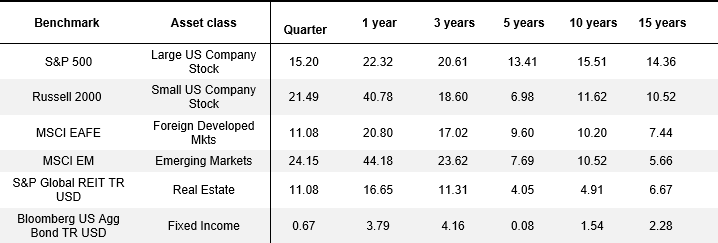
The Russell 2000, which tracks shares of smaller companies in the US, climbed over 22% in the first six months of the year benefiting from more reasonable valuations than larger company stocks (see chart below). Smaller company stocks, which have been out of favor for years, have almost doubled the 1-year performance of the S&P 500, supporting the benefits of portfolio diversification.
The Magnificent Seven group of mega-cap tech stocks shed more than $2.2 trillion in value in June and are collectively down 2% YTD.1 Concerns about the hundreds of billions of dollars that some of the companies are spending on AI infrastructure are worrying investors. On the other hand, the companies supplying the key components for AI infrastructure such as chips, cables, cooling systems and connectors are benefiting.
Businesses curtailing spending on AI after cost increases are adding to uncertainty about the economics of the AI value proposition. The switch from flat-fee pricing to usage-based pricing has caused companies to burn through AI budgets and necessitated the implementation of per employee limits on AI spending. According to a recent KPMG Global AI Pulse survey, 49% of organizations surveyed have delayed or scaled back AI agent deployments when costs started outweighing benefits.2
Despite a deepening economic crisis across Asia from the cost of energy due to the Iran conflict, Emerging Markets stocks are having a banner year, driven by the performance of companies in South Korea, Singapore, Taiwan and Japan that provide memory chips and other electronics needed for AI infrastructure spending.
Fixed income returns were slightly positive this past quarter as interest income was offset by investor expectations of future rate increases. Bond markets are sensitive to interest rate change, and the latest Federal Reserve meeting results (see below) didn’t help.
SpaceX
On June 12th, Space Exploration Technologies, otherwise known as SpaceX, raised $85.7 billion from an initial public offering that vaulted the total company close to a $3 trillion valuation, making the total market capitalization temporarily higher than Amazon’s. In 2025, Amazon’s revenue was $717 billion with net income of $78 billion. SpaceX’s revenue was $19 billion with a net loss of $5 billion. How does the market value of SpaceX make sense? A limited supply, only 5% of total SpaceX shares, was offered for sale, along with a predetermined initial price of $135/share and frenzied demand from retail investors, explains some of the dynamics of the valuation. Once insider shares can start being sold, which begins two days after the company’s first quarterly report and culminates a year after the IPO date, the profitability dreams of sending people to Mars and data centers in outer space may come back down to earth and result in a cratering stock price.
Iran Conflict
The Strait of Hormuz was “open” again after a new extension of the cease-fire agreement first signed in early April, and the price of crude oil began trending back towards pre-war levels. But the end of the conflict remains uncertain and hostilities could reignite. It will take time for US consumers to see the price of gasoline retreat toward pre-conflict levels. The overall crisis and fuel price inflation so far has thankfully been mitigated by shortened work-weeks, depletion of strategic reserves, increased exports from non-Hormuz oil producing countries (like the US and Brazil), alternative Middle East pipelines and overall improvements in energy efficiency and renewable energy.
Alan Greenspan
Alan Greenspan, the Federal Reserve Chair from 1987-2006, died at the age of 100 in June. As the second-longest-serving [Fed Chair] in the position, he coined the term “irrational exuberance” that became the title of a book by Robert Shiller, which predicted the dot-com crash. The pinnacle of his success was cushioning the economy from the 1997-98 emerging markets crisis and Long-Term Capital Management hedge fund implosion. On the other hand, critics argue that he didn’t do enough to protect the economy from the 2007-2009 financial crisis, which happened after he left office in 2006.
Interest Rates
The new Federal Reserve Chair, Kevin Warsh, held his first Federal Open Market Committee meeting from June 16-17 during which the Fed pivoted toward expectations of raising interest rates in 2026. The focus of rate increases is fighting inflation which has stayed stubbornly above the Fed’s 2% target and was exacerbated by the Iran conflict and AI spending.3 The most recent US unemployment report showed a cooling labor market providing hopes that the Fed will pivot away from the current “higher for longer” positioning.4
Final Thoughts
The latest Social Security Administration Trustees report stated that based on their best estimates “The Old-Age and Survivors Insurance (OASI) Trust Fund will be able to pay 100 percent of total scheduled benefits until the fourth quarter of 2032, one quarter earlier than projected last year.” 5 The report listed three reasons for the change. 1) Lower expected long-term fertility rates. 2) Lower near- and long-term immigration. 3) The One Big Beautiful Bill Act (OBBBA) both increased and made permanent the larger standard deduction of the 2017 Tax Cuts and Jobs Act which will lead to lower levels of revenue in the future from income taxation of Social Security benefits.
Fortunately, there are many ways that the shortfall can be fixed by Congress. Raising the full retirement age for future generations (which hasn’t been done since 1983), raising the payroll tax cap so higher earners pay more into the trust fund, changing the cost-of-living adjustments, and eliminating the payroll tax deduction for health insurance are all levers that can be pulled to fix the problem. A neat tool you can use to see how easy it is to fix the problem can be found here: https://www.crfb.org/socialsecurityreformer/. The bottom line is that it will be fixed but doing so sooner rather than later would allow for a broader range of solutions and more time to implement the changes.
The following table summarizes the performance of major asset classes through 06/30/2026:
Disclaimer:
The information provided is for educational and informational purposes only and does not constitute investment advice and it should not be relied on as such. It should not be considered a solicitation to buy or an offer to sell a security. It does not take into account any investor’s particular investment objectives, strategies, tax status or investment horizon. The views expressed in this commentary are subject to change based on market and other conditions. These documents may contain certain statements that may be deemed forward-looking statements. Please note that any such statements are not guarantees of any future performance and actual results or developments may differ materially from those projected. Any projections, market outlooks, or estimates are based upon certain assumptions and should not be construed as indicative of actual events that will occur.
All information has been obtained from sources believed to be reliable, but its accuracy is not guaranteed. There is no representation or warranty as to the current accuracy, reliability or completeness of, nor liability for, decisions based on such information and it should not be relied on as such.
Milestone Financial Planning, LLC (“Milestone”) is a fee-only financial planning firm and registered investment advisor headquartered in Bedford, NH. Registration does not imply a certain level of skill or training. Milestone works with clients on an ongoing, long-term basis, providing financial planning, tax planning, retirement planning, and investment management services. Fees are based on assets under management and may include a financial planning fee. Milestone receives no commissions or referral fees and, as a fiduciary, is required to act in clients’ best interests. Advisory services are offered only where Milestone and its representatives are properly licensed or exempt from licensure. More information, including fees and principal risks, is available in Milestone’s Form ADV Part 2A. For help with your investments or financial planning, contact one of our fee-only advisors.







Market Review
The Russell 2000, which tracks shares of smaller companies in the US, climbed over 22% in the first six months of the year benefiting from more reasonable valuations than larger company stocks (see chart below). Smaller company stocks, which have been out of favor for years, have almost doubled the 1-year performance of the S&P 500, supporting the benefits of portfolio diversification.
The Magnificent Seven group of mega-cap tech stocks shed more than $2.2 trillion in value in June and are collectively down 2% YTD.1 Concerns about the hundreds of billions of dollars that some of the companies are spending on AI infrastructure are worrying investors. On the other hand, the companies supplying the key components for AI infrastructure such as chips, cables, cooling systems and connectors are benefiting.
Businesses curtailing spending on AI after cost increases are adding to uncertainty about the economics of the AI value proposition. The switch from flat-fee pricing to usage-based pricing has caused companies to burn through AI budgets and necessitated the implementation of per employee limits on AI spending. According to a recent KPMG Global AI Pulse survey, 49% of organizations surveyed have delayed or scaled back AI agent deployments when costs started outweighing benefits.2
Despite a deepening economic crisis across Asia from the cost of energy due to the Iran conflict, Emerging Markets stocks are having a banner year, driven by the performance of companies in South Korea, Singapore, Taiwan and Japan that provide memory chips and other electronics needed for AI infrastructure spending.
Fixed income returns were slightly positive this past quarter as interest income was offset by investor expectations of future rate increases. Bond markets are sensitive to interest rate change, and the latest Federal Reserve meeting results (see below) didn’t help.
SpaceX
On June 12th, Space Exploration Technologies, otherwise known as SpaceX, raised $85.7 billion from an initial public offering that vaulted the total company close to a $3 trillion valuation, making the total market capitalization temporarily higher than Amazon’s. In 2025, Amazon’s revenue was $717 billion with net income of $78 billion. SpaceX’s revenue was $19 billion with a net loss of $5 billion. How does the market value of SpaceX make sense? A limited supply, only 5% of total SpaceX shares, was offered for sale, along with a predetermined initial price of $135/share and frenzied demand from retail investors, explains some of the dynamics of the valuation. Once insider shares can start being sold, which begins two days after the company’s first quarterly report and culminates a year after the IPO date, the profitability dreams of sending people to Mars and data centers in outer space may come back down to earth and result in a cratering stock price.
Iran Conflict
The Strait of Hormuz was “open” again after a new extension of the cease-fire agreement first signed in early April, and the price of crude oil began trending back towards pre-war levels. But the end of the conflict remains uncertain and hostilities could reignite. It will take time for US consumers to see the price of gasoline retreat toward pre-conflict levels. The overall crisis and fuel price inflation so far has thankfully been mitigated by shortened work-weeks, depletion of strategic reserves, increased exports from non-Hormuz oil producing countries (like the US and Brazil), alternative Middle East pipelines and overall improvements in energy efficiency and renewable energy.
Alan Greenspan
Alan Greenspan, the Federal Reserve Chair from 1987-2006, died at the age of 100 in June. As the second-longest-serving [Fed Chair] in the position, he coined the term “irrational exuberance” that became the title of a book by Robert Shiller, which predicted the dot-com crash. The pinnacle of his success was cushioning the economy from the 1997-98 emerging markets crisis and Long-Term Capital Management hedge fund implosion. On the other hand, critics argue that he didn’t do enough to protect the economy from the 2007-2009 financial crisis, which happened after he left office in 2006.
Interest Rates
The new Federal Reserve Chair, Kevin Warsh, held his first Federal Open Market Committee meeting from June 16-17 during which the Fed pivoted toward expectations of raising interest rates in 2026. The focus of rate increases is fighting inflation which has stayed stubbornly above the Fed’s 2% target and was exacerbated by the Iran conflict and AI spending.3 The most recent US unemployment report showed a cooling labor market providing hopes that the Fed will pivot away from the current “higher for longer” positioning.4
Final Thoughts
The latest Social Security Administration Trustees report stated that based on their best estimates “The Old-Age and Survivors Insurance (OASI) Trust Fund will be able to pay 100 percent of total scheduled benefits until the fourth quarter of 2032, one quarter earlier than projected last year.” 5 The report listed three reasons for the change. 1) Lower expected long-term fertility rates. 2) Lower near- and long-term immigration. 3) The One Big Beautiful Bill Act (OBBBA) both increased and made permanent the larger standard deduction of the 2017 Tax Cuts and Jobs Act which will lead to lower levels of revenue in the future from income taxation of Social Security benefits.
Fortunately, there are many ways that the shortfall can be fixed by Congress. Raising the full retirement age for future generations (which hasn’t been done since 1983), raising the payroll tax cap so higher earners pay more into the trust fund, changing the cost-of-living adjustments, and eliminating the payroll tax deduction for health insurance are all levers that can be pulled to fix the problem. A neat tool you can use to see how easy it is to fix the problem can be found here: https://www.crfb.org/socialsecurityreformer/. The bottom line is that it will be fixed but doing so sooner rather than later would allow for a broader range of solutions and more time to implement the changes.
The following table summarizes the performance of major asset classes through 06/30/2026:
Disclaimer:
The information provided is for educational and informational purposes only and does not constitute investment advice and it should not be relied on as such. It should not be considered a solicitation to buy or an offer to sell a security. It does not take into account any investor’s particular investment objectives, strategies, tax status or investment horizon. The views expressed in this commentary are subject to change based on market and other conditions. These documents may contain certain statements that may be deemed forward-looking statements. Please note that any such statements are not guarantees of any future performance and actual results or developments may differ materially from those projected. Any projections, market outlooks, or estimates are based upon certain assumptions and should not be construed as indicative of actual events that will occur.
All information has been obtained from sources believed to be reliable, but its accuracy is not guaranteed. There is no representation or warranty as to the current accuracy, reliability or completeness of, nor liability for, decisions based on such information and it should not be relied on as such.
Milestone Financial Planning, LLC (“Milestone”) is a fee-only financial planning firm and registered investment advisor headquartered in Bedford, NH. Registration does not imply a certain level of skill or training. Milestone works with clients on an ongoing, long-term basis, providing financial planning, tax planning, retirement planning, and investment management services. Fees are based on assets under management and may include a financial planning fee. Milestone receives no commissions or referral fees and, as a fiduciary, is required to act in clients’ best interests. Advisory services are offered only where Milestone and its representatives are properly licensed or exempt from licensure. More information, including fees and principal risks, is available in Milestone’s Form ADV Part 2A. For help with your investments or financial planning, contact one of our fee-only advisors.
Share:
Sign up below to receive blog and event updates.
Speak with an Advisor
Related articles
November 2025 Market Commentary
October 2025 Market Commentary
August 2025 Market Commentary