Market Review
This was one crazy quarter for the market and the world. We started off the year talking about AI bubbles, concentration in the S&P 500, and Kevin Warsh as the next Fed Chairman. Then the economic news pivoted to the Supreme Court overturning the IEEPA tariffs (quickly followed by new 10% across-the-board tariffs), an AI job apocalypse, and then, boom, a war in the Middle East choking off 20% of the world’s oil supply.
Equity returns in developed international and emerging markets continued their hot streak early in the year, but those gains were wiped out as fear of surging energy costs hit economies across the globe. US equity market returns showed strength during January and February but got knocked back to their starting point in March with the onslaught of the war against Iran.
Fixed income returns remained flat this past quarter as interest income was essentially wiped out by falling bond prices. Bond markets lost ground due to concerns that the Fed is done cutting interest rates for 2026 and might even have to raise them to fight inflation.
Interestingly, from a 3-month perspective, despite significant intra-quarter volatility, investors who held onto their diversified portfolios ended the quarter almost at the point where they started. Considering the high degree of uncertainty and craziness of events, it could have been worse.
Interest Rates
The Federal Reserve held interest rates steady at their last meeting in March as higher energy prices from the Iran war threaten to prolong the yearslong fight against inflation. The vote was 11-1 to hold the benchmark federal funds rate in the current range between 3.5% and 3.75%. This represents a consensus not to cut rates in the face of surging energy costs, and a positive March jobs report.
There seems to be little wiggle room to continue interest rate cuts at this time. Future expectations from the Fed are for between zero and 1 rate cut for the remainder of 2026. Of particular concern is rising inflation from the conflict in the Middle East. The OECD (Organization for Economic Co-Operation and Development) predicts U.S. inflation to increase to 4.2% in 20261 , which is a clear headwind against reducing interest rates further.
Tariffs
After the Supreme Court struck down the IEEPA tariffs in late February, President Trump quickly imposed a 10% temporary import surcharge to address fundamental international payment problems.2 So-called “Liberation Day” was little more than one short (long?) year ago, when all the tariff drama began. The new 10% tariff is only good for 150 days (until July 26, 2026) but of course it is unknown if new tariffs will be enacted thereafter with new justification. The tariffs don’t seem to be helping U.S. businesses and consumers. The New York Federal Reserve published a report in February that found U.S. consumers and businesses are paying 90% of the tariffs since their enactment in 2025.3 If this is the case, it would seem to make the case to letting the tariffs lapse for good.
In the meantime, businesses, shipping companies, importers, and individuals are all wondering how they are going to be refunded the $175 billion (or more) in IEEPA tariffs previously paid. More than 3,000 lawsuits have been filed against the government in the Court of International Trade by companies hoping to maximize their chances of getting a refund quickly.
Oil Prices
It’s no secret that gas and oil prices spiked after the US and Israel struck Iran in late February. The price of gasoline, jet fuel, heating oil and natural gas have all increased in the U.S. Fortunately for those in the US, we have not reached the point of energy rationing, as has been the case in other parts of the world that depend more heavily on oil coming through the Strait of Hormuz.
One indicator of the impact is a recent announcement by the U.S. Postal Service of a first-ever temporary price increase specifically to help cover rising fuel, insurance, vehicle maintenance and other costs. The carrier plans to raise prices 8% starting April 26 and ending next January.4
Just as taxpayers in the U.S. may be receiving larger refunds from tax cuts from last year’s tax bill, they are diverting the savings to pay for auto fuel, airline fares, heating bills, and other increased costs.
Other News
In other news, the Department of Labor announced on March 30th that they would allow 401(k) plan administrators a set of “process-based safe harbors for plan fiduciaries to use when selecting designated investment alternatives.”5 These “investment alternatives” include such vehicles as private equity, private credit, private real estate, digital assets, and commodities. Adjectives associated with these types of investments include volatile, illiquid, expensive, and non-tradeable. In our opinion, investors who have the necessary investment experience, sufficient personal capital, and the risk tolerance to invest in alternative investments generally should do so outside of workplace plans. Hopefully the fiduciaries that are supposed to be putting their employees’ interests first when sponsoring 401(k) plans, see fit to avoid adding complicated and illiquid alternative investments to their investment offerings. It is a horrible idea.
The final highlight from last quarter is the significant drop in gold prices during February and March. Gold advocates hope for and expound on the metal being a “safe haven” for investors during times of uncertainty. That doesn’t always seem to be the case, and it’s another reason we do not support gold as an asset class in your portfolio.
The following table summarizes the performance of major asset classes through 03/31/2026:
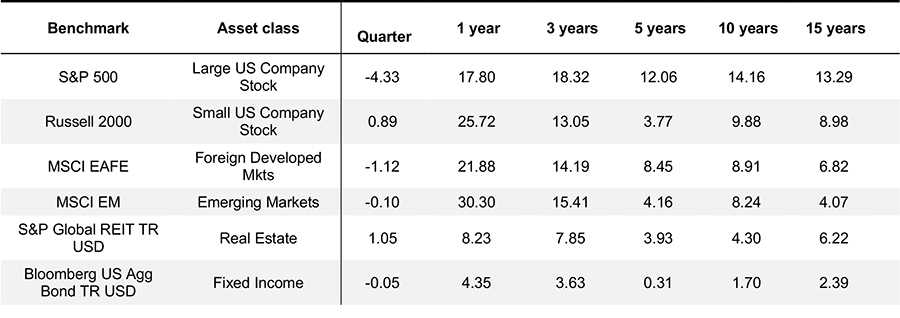
Note: Return data obtained from Dimensional Fund Advisors database. Returns include dividends and reinvestments.
Regards,
The Milestone Team
Reminders
Please contact us if your financial goals or circumstances have changed or if we can address your needs. Also, please let us know as soon as possible about any change to your contact information.
SEC regulations require us to remind you to compare our reports with the statements provided by the independent custodian that holds your accounts (Fidelity). Please let us know if there are any discrepancies, or if you are not receiving separate statements (or notification of their online availability) directly from the custodian. Please remember that past performance does not predict future results.
Disclaimer: This is not to be considered investment, tax, or financial advice. Please review your personal situation with your tax and/or financial advisor. Milestone Financial Planning, LLC (Milestone) is a fee-only financial planning firm and registered investment advisor in Bedford, NH. Milestone works with clients on a long-term, ongoing basis. Our fees are based on the assets that we manage and may include an annual financial planning subscription fee. Clients receive financial planning, tax planning, retirement planning, and investment management services and have unlimited access to our advisors. We receive no commissions or referral fees. We put our client’s interests first. If you need assistance with your investments or financial planning, please reach out to one of our fee-only advisors. Advisory services are only offered to clients or prospective clients where Milestone and its representatives are properly licensed or exempt from licensure. Past performance shown is not indicative of future results, which could differ substantially.







Market Review
This was one crazy quarter for the market and the world. We started off the year talking about AI bubbles, concentration in the S&P 500, and Kevin Warsh as the next Fed Chairman. Then the economic news pivoted to the Supreme Court overturning the IEEPA tariffs (quickly followed by new 10% across-the-board tariffs), an AI job apocalypse, and then, boom, a war in the Middle East choking off 20% of the world’s oil supply.
Equity returns in developed international and emerging markets continued their hot streak early in the year, but those gains were wiped out as fear of surging energy costs hit economies across the globe. US equity market returns showed strength during January and February but got knocked back to their starting point in March with the onslaught of the war against Iran.
Fixed income returns remained flat this past quarter as interest income was essentially wiped out by falling bond prices. Bond markets lost ground due to concerns that the Fed is done cutting interest rates for 2026 and might even have to raise them to fight inflation.
Interestingly, from a 3-month perspective, despite significant intra-quarter volatility, investors who held onto their diversified portfolios ended the quarter almost at the point where they started. Considering the high degree of uncertainty and craziness of events, it could have been worse.
Interest Rates
The Federal Reserve held interest rates steady at their last meeting in March as higher energy prices from the Iran war threaten to prolong the yearslong fight against inflation. The vote was 11-1 to hold the benchmark federal funds rate in the current range between 3.5% and 3.75%. This represents a consensus not to cut rates in the face of surging energy costs, and a positive March jobs report.
There seems to be little wiggle room to continue interest rate cuts at this time. Future expectations from the Fed are for between zero and 1 rate cut for the remainder of 2026. Of particular concern is rising inflation from the conflict in the Middle East. The OECD (Organization for Economic Co-Operation and Development) predicts U.S. inflation to increase to 4.2% in 20261 , which is a clear headwind against reducing interest rates further.
Tariffs
After the Supreme Court struck down the IEEPA tariffs in late February, President Trump quickly imposed a 10% temporary import surcharge to address fundamental international payment problems.2 So-called “Liberation Day” was little more than one short (long?) year ago, when all the tariff drama began. The new 10% tariff is only good for 150 days (until July 26, 2026) but of course it is unknown if new tariffs will be enacted thereafter with new justification. The tariffs don’t seem to be helping U.S. businesses and consumers. The New York Federal Reserve published a report in February that found U.S. consumers and businesses are paying 90% of the tariffs since their enactment in 2025.3 If this is the case, it would seem to make the case to letting the tariffs lapse for good.
In the meantime, businesses, shipping companies, importers, and individuals are all wondering how they are going to be refunded the $175 billion (or more) in IEEPA tariffs previously paid. More than 3,000 lawsuits have been filed against the government in the Court of International Trade by companies hoping to maximize their chances of getting a refund quickly.
Oil Prices
It’s no secret that gas and oil prices spiked after the US and Israel struck Iran in late February. The price of gasoline, jet fuel, heating oil and natural gas have all increased in the U.S. Fortunately for those in the US, we have not reached the point of energy rationing, as has been the case in other parts of the world that depend more heavily on oil coming through the Strait of Hormuz.
One indicator of the impact is a recent announcement by the U.S. Postal Service of a first-ever temporary price increase specifically to help cover rising fuel, insurance, vehicle maintenance and other costs. The carrier plans to raise prices 8% starting April 26 and ending next January.4
Just as taxpayers in the U.S. may be receiving larger refunds from tax cuts from last year’s tax bill, they are diverting the savings to pay for auto fuel, airline fares, heating bills, and other increased costs.
Other News
In other news, the Department of Labor announced on March 30th that they would allow 401(k) plan administrators a set of “process-based safe harbors for plan fiduciaries to use when selecting designated investment alternatives.”5 These “investment alternatives” include such vehicles as private equity, private credit, private real estate, digital assets, and commodities. Adjectives associated with these types of investments include volatile, illiquid, expensive, and non-tradeable. In our opinion, investors who have the necessary investment experience, sufficient personal capital, and the risk tolerance to invest in alternative investments generally should do so outside of workplace plans. Hopefully the fiduciaries that are supposed to be putting their employees’ interests first when sponsoring 401(k) plans, see fit to avoid adding complicated and illiquid alternative investments to their investment offerings. It is a horrible idea.
The final highlight from last quarter is the significant drop in gold prices during February and March. Gold advocates hope for and expound on the metal being a “safe haven” for investors during times of uncertainty. That doesn’t always seem to be the case, and it’s another reason we do not support gold as an asset class in your portfolio.
The following table summarizes the performance of major asset classes through 03/31/2026:
Note: Return data obtained from Dimensional Fund Advisors database. Returns include dividends and reinvestments.
Regards,
The Milestone Team
1 https://www.oecd.org/en/publications/oecd-economic-outlook-interim-report-march-2026_d4623013-en.html
2 https://www.whitehouse.gov/presidential-actions/2026/02/imposing-a-temporary-import-surcharge-to-address-fundamental-international-payments-problems/
3 https://libertystreeteconomics.newyorkfed.org/2026/02/who-is-paying-for-the-2025-u-s-tariffs/
4 https://about.usps.com/newsroom/national-releases/2026/0325-usps-announces-transportation-related-time-limited-price-change.htm
5 https://www.dol.gov/newsroom/releases/ebsa/ebsa20260330
Reminders
Please contact us if your financial goals or circumstances have changed or if we can address your needs. Also, please let us know as soon as possible about any change to your contact information.
SEC regulations require us to remind you to compare our reports with the statements provided by the independent custodian that holds your accounts (Fidelity). Please let us know if there are any discrepancies, or if you are not receiving separate statements (or notification of their online availability) directly from the custodian. Please remember that past performance does not predict future results.
Disclaimer: This is not to be considered investment, tax, or financial advice. Please review your personal situation with your tax and/or financial advisor. Milestone Financial Planning, LLC (Milestone) is a fee-only financial planning firm and registered investment advisor in Bedford, NH. Milestone works with clients on a long-term, ongoing basis. Our fees are based on the assets that we manage and may include an annual financial planning subscription fee. Clients receive financial planning, tax planning, retirement planning, and investment management services and have unlimited access to our advisors. We receive no commissions or referral fees. We put our client’s interests first. If you need assistance with your investments or financial planning, please reach out to one of our fee-only advisors. Advisory services are only offered to clients or prospective clients where Milestone and its representatives are properly licensed or exempt from licensure. Past performance shown is not indicative of future results, which could differ substantially.
Share:
Signup below to receive blog and event updates.
Related articles
2025 SQ2 Market Commentary
2025 Q2 Market Commentary
2025 SQ1 Market Commentary