Market Review
Financial markets experienced significant volatility in April, driven largely by escalating trade tensions and unpredictable policy shifts from the White House. For example, on April 9th the S&P 500 rose 9.5% (due to the country specific tariff pause) but then fell 3.4% the following day (China announcement of 125% tariff on U.S. goods). As we move into May, intraday movements in the markets seemed to have calmed down.
Beyond tariffs, in late April investors were spooked by President Trump’s comments on Jerome Powell, Chair of the Federal Reserve. The President was unhappy with Mr. Powell’s decision not to reduce interest rates and made comments on social media that he might fire him (which he later walked back). It seems for now that Powell’s job is safe, but he has a tough job ahead of him navigating tariff inflation and a possible slowdown of GDP growth hoping to avoid stagflation in the U.S. economy. On May 7th the Fed left interest rates steady, opting to wait and see if any progress is made on reducing tariffs with China and the rest of the world before making any adjustments to interest rates.
Diversification has continued to help investors in 2025 as international developed (+12.02% YTD) and emerging markets (+4.39% YTD) stocks both have positive returns for the year. Fixed income continues to deliver yield and has a positive return (+3.18% YTD) for the year. The S&P 500 is down -4.92% YTD but at the level it was last September so in the grand scheme of things, not catastrophic.
Due to the volatility mentioned earlier, April was a tough month to tune out the noise in the market, but it seems individual investors did just that. According to an article in the Wall Street Journal[1], Vanguard estimates that more than 97% of investors in its 401(k) retirement plans avoided trading through mid-April. Approximately 1/5th of investors even increased their saving rate!
YTD return %s as of 4/30/2025.
Closing Thoughts
This past week at his annual shareholders’ meeting, Warren Buffet announced that he will relinquish his role as CEO of Berkshire Hathaway to Greg Abel, his current deputy. At 94, it’s probably time for Warren to give up day-to-day control of Berkshire, but it also feels like the end of an era for an iconic figure in the investing world.
On May 6th, New Hampshire became the first state in the nation to allow the state treasurer to invest up to 5% of public funds in digital assets, such as bitcoin. What could go wrong with investing state funds in a highly volatile and speculative asset? Luckily for New Hampshire residents, according to Monica Mezzapelle, the New Hampshire State Treasurer, an investment in digital assets could only be made in $30 million of what the state considers long-term investments which would limit the total investment to digital asset investment to $1.5 million.
The following table summarizes the performance of major asset classes through 04/30/2025:
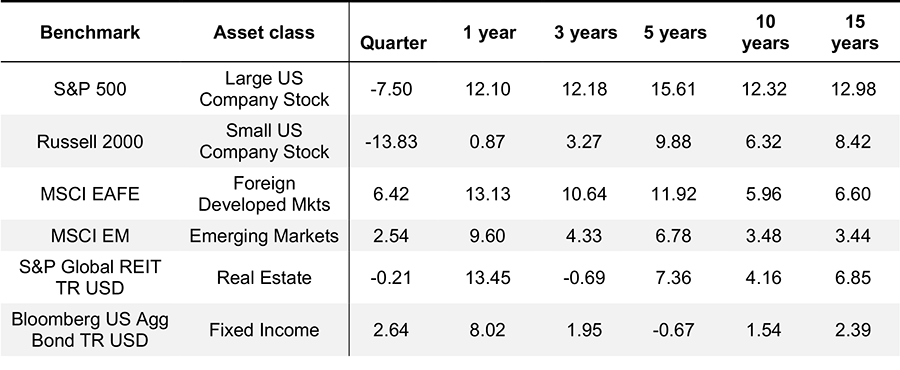
Note: Return data obtained from Dimensional Fund Advisors database. Returns include dividends and reinvestments.
[1] Gregory Zuckerman and Gunjan Banerji, “As Markets Swooned, Pros Sold—and Individuals Pounced,” Wall Street Journal, April 25, 2025, https://www.wsj.com/finance/investing/market-chaos-professional-investors-sold-stocks-individuals-bought-d1c325c6.
Disclaimer:
This material is provided for educational and informational purposes only and is not investment, tax, legal, or financial advice. It does not consider any individual’s investment objectives, strategies, tax situation, or time horizon, and it is not an offer to sell or a solicitation to buy any security. Financial aid rules, tax laws, and school policies change frequently and vary by institution; figures cited are as of October 2026. Investing in a 529 plan involves risk, including the possible loss of principal. Before investing, review the plan’s offering documents for its investment objectives, risks, fees, and expenses, and consider whether your home state offers tax benefits only for its own plan. Please review your personal situation with your tax and/or financial advisor before acting.
Views expressed are subject to change based on market and other conditions. Any projections, market outlooks, estimates, or other forward-looking views are based on assumptions, are not indicative of future performance, and actual results may differ materially. Information is obtained from third-party sources believed to be accurate, but Milestone makes no representation as to its accuracy, completeness, or timeliness and accepts no liability for decisions based on it. Past performance is not indicative of future results. All investments involve risk, including the possible loss of principal.
Milestone Financial Planning, LLC (“Milestone”) is a fee-only financial planning firm and registered investment advisor headquartered in Bedford, NH. Registration does not imply a certain level of skill or training. Milestone works with clients on an ongoing, long-term basis, providing financial planning, tax planning, retirement planning, and investment management services. Fees are based on assets under management and may include a financial planning fee. Milestone receives no commissions or referral fees and, as a fiduciary, is required to act in clients’ best interests. Advisory services are offered only where Milestone and its representatives are properly licensed or exempt from licensure. More information, including fees and principal risks, is available in Milestone’s Form ADV Part 2A. For help with your investments or financial planning, contact one of our fee-only advisors.







Market Review
Financial markets experienced significant volatility in April, driven largely by escalating trade tensions and unpredictable policy shifts from the White House. For example, on April 9th the S&P 500 rose 9.5% (due to the country specific tariff pause) but then fell 3.4% the following day (China announcement of 125% tariff on U.S. goods). As we move into May, intraday movements in the markets seemed to have calmed down.
Beyond tariffs, in late April investors were spooked by President Trump’s comments on Jerome Powell, Chair of the Federal Reserve. The President was unhappy with Mr. Powell’s decision not to reduce interest rates and made comments on social media that he might fire him (which he later walked back). It seems for now that Powell’s job is safe, but he has a tough job ahead of him navigating tariff inflation and a possible slowdown of GDP growth hoping to avoid stagflation in the U.S. economy. On May 7th the Fed left interest rates steady, opting to wait and see if any progress is made on reducing tariffs with China and the rest of the world before making any adjustments to interest rates.
Diversification has continued to help investors in 2025 as international developed (+12.02% YTD) and emerging markets (+4.39% YTD) stocks both have positive returns for the year. Fixed income continues to deliver yield and has a positive return (+3.18% YTD) for the year. The S&P 500 is down -4.92% YTD but at the level it was last September so in the grand scheme of things, not catastrophic.
Due to the volatility mentioned earlier, April was a tough month to tune out the noise in the market, but it seems individual investors did just that. According to an article in the Wall Street Journal[1], Vanguard estimates that more than 97% of investors in its 401(k) retirement plans avoided trading through mid-April. Approximately 1/5th of investors even increased their saving rate!
YTD return %s as of 4/30/2025.
Closing Thoughts
This past week at his annual shareholders’ meeting, Warren Buffet announced that he will relinquish his role as CEO of Berkshire Hathaway to Greg Abel, his current deputy. At 94, it’s probably time for Warren to give up day-to-day control of Berkshire, but it also feels like the end of an era for an iconic figure in the investing world.
On May 6th, New Hampshire became the first state in the nation to allow the state treasurer to invest up to 5% of public funds in digital assets, such as bitcoin. What could go wrong with investing state funds in a highly volatile and speculative asset? Luckily for New Hampshire residents, according to Monica Mezzapelle, the New Hampshire State Treasurer, an investment in digital assets could only be made in $30 million of what the state considers long-term investments which would limit the total investment to digital asset investment to $1.5 million.
The following table summarizes the performance of major asset classes through 04/30/2025:
Note: Return data obtained from Dimensional Fund Advisors database. Returns include dividends and reinvestments.
[1] Gregory Zuckerman and Gunjan Banerji, “As Markets Swooned, Pros Sold—and Individuals Pounced,” Wall Street Journal, April 25, 2025, https://www.wsj.com/finance/investing/market-chaos-professional-investors-sold-stocks-individuals-bought-d1c325c6.
Disclaimer:
This material is provided for educational and informational purposes only and is not investment, tax, legal, or financial advice. It does not consider any individual’s investment objectives, strategies, tax situation, or time horizon, and it is not an offer to sell or a solicitation to buy any security. Financial aid rules, tax laws, and school policies change frequently and vary by institution; figures cited are as of October 2026. Investing in a 529 plan involves risk, including the possible loss of principal. Before investing, review the plan’s offering documents for its investment objectives, risks, fees, and expenses, and consider whether your home state offers tax benefits only for its own plan. Please review your personal situation with your tax and/or financial advisor before acting.
Views expressed are subject to change based on market and other conditions. Any projections, market outlooks, estimates, or other forward-looking views are based on assumptions, are not indicative of future performance, and actual results may differ materially. Information is obtained from third-party sources believed to be accurate, but Milestone makes no representation as to its accuracy, completeness, or timeliness and accepts no liability for decisions based on it. Past performance is not indicative of future results. All investments involve risk, including the possible loss of principal.
Milestone Financial Planning, LLC (“Milestone”) is a fee-only financial planning firm and registered investment advisor headquartered in Bedford, NH. Registration does not imply a certain level of skill or training. Milestone works with clients on an ongoing, long-term basis, providing financial planning, tax planning, retirement planning, and investment management services. Fees are based on assets under management and may include a financial planning fee. Milestone receives no commissions or referral fees and, as a fiduciary, is required to act in clients’ best interests. Advisory services are offered only where Milestone and its representatives are properly licensed or exempt from licensure. More information, including fees and principal risks, is available in Milestone’s Form ADV Part 2A. For help with your investments or financial planning, contact one of our fee-only advisors.
Share:
Sign up below to receive blog and event updates.
Speak with an Advisor
Related articles
January 2026 Market Commentary
November 2025 Market Commentary
October 2025 Market Commentary