
Last updated: November 2026
The short answer: Medicare open enrollment for 2027 coverage runs from October 15 to December 7, 2026. During this window you can switch Medicare Advantage plans, change or add a Part D prescription drug plan, or move between Original Medicare and Medicare Advantage. Any changes take effect January 1, 2027. Because premiums, covered drugs, and pharmacy networks change every year, it’s worth reviewing your coverage even if you were happy with your plan this year.
If you’re 65 or older, by now you should have received your annual installment of the official U.S. government Medicare handbook, Medicare & You 2027. Your mailbox is also probably full of Medicare Advantage-related flyers from insurance companies trying to win your business.
When Is Medicare Open Enrollment for 2027?
The annual open enrollment period for Medicare started on October 15 and lasts until December 7. It is the main time every year that Medicare beneficiaries have an opportunity to modify their Medicare coverage. During the open enrollment period, you can switch or add a Medicare Advantage plan, switch to or add a Part D prescription drug plan, and, in some states, including Massachusetts, switch from an Advantage to a Medigap plan. Any changes you make will take effect on January 1, 2027.
Why You Should Review Your Medicare Plan Every Year
So many changes are coming for 2027, especially for Medicare Part D plans. It’s always important to review your prescription drug plan during Medicare’s open enrollment period, but this year, there are more changes than we’ve seen in a long time. Medicare plans can change significantly from year to year, and 2027 brings several updates worth reviewing. Premiums, prescription drug coverage, provider networks, and out-of-pocket expenses may look different from 2026. Taking time to compare your options can help you determine whether your current coverage still meets your needs. Do not assume that the plans you had last year will be the best plan for you next year. Premiums, benefits, and coverage changes require you to go through the analysis of determining the best plan annually, especially this year.
This blog post cannot cover everything that you will find in the Medicare & You 2027 handbook, but we’ll cover the basics to give you a general understanding of Medicare and your options during the open enrollment period. Some 2027 amounts (Part A and Part B premiums and deductibles) have not been issued yet.
What’s Changing in Medicare for 2027?
| Cost | 2026 | 2027 |
|---|---|---|
| Part D out-of-pocket cap (covered drugs) | $2,100 | $2,400 |
| Part D maximum deductible | $615 | $700 |
| Medicare Advantage out-of-pocket limit (in-network) | $9,250 | $9,850 |
| Medicare Advantage out-of-pocket limit (in- and out-of-network combined) | $13,900 | $14,800 |
| High-deductible Medigap Plan G/F deductible | $2,950 | $3,050 |
| Part B standard monthly premium | $202.90 | $209.50 (projected) |
| Part B annual deductible | $283 | $292 (projected) |
| Part A hospital deductible (per benefit period) | $1,736 | $1,788 (projected) |
Beyond the numbers above, a few bigger changes are worth knowing about for 2027: a temporary federal program that helped hold down Part D premiums ends after 2026, so some stand-alone drug plan premiums may rise; Medicare-negotiated prices take effect for another group of 15 drugs (including Ozempic and Wegovy); and many people will have fewer stand-alone Part D and Medicare Advantage plans to choose from than they did this year.
Fewer Plan Choices and Broker Changes
Several major insurers have announced cuts or elimination of commissions paid to independent agents and brokers for enrolling beneficiaries in certain Medicare Advantage and Part D prescription drug plans. This shift impacts the industry greatly, resulting in independent brokers dropping plans or exiting the market. Agents may not recommend the lowest-cost or the best-fit plan if it is outside their covered network.
Some Medicare Part D insurers are pulling out of the market entirely. In Massachusetts, the number of stand-alone Medicare Part D plans will decrease from 11 in 2026 to 10 in 2027. If your current plan is being discontinued, review your available options during open enrollment to avoid an unexpected change in coverage!
Provider Networks and Plan Name Changes
Advantage plan network changes make the choice of provider a key factor to weigh. Across the United States, Advantage plan enrollees had access to 50% of the doctors available to those on traditional Medicare.
As a result of corporate mergers and sales, the name of the plan may have changed. For example, Cigna has changed to HealthSpring.
Drug Coverage, Formularies, and Pharmacy Networks
The drugs an insurer covers under their plan (the “formulary”) will be different. Expect fewer drugs to be included in each insurer’s plan. Some drugs may now be more expensive, while others could be less.
The $2,400 annual Part D out-of-pocket cap for 2027 applies to qualifying costs for covered Part D prescription drugs. It does not include monthly plan premiums or medications that aren’t covered by your plan. Check each plan’s formulary, drug pricing tiers, and pharmacy network to understand what you may pay.
Pharmacy choice matters. Typically, you get the best prices when a pharmacy is “preferred, in-network,” not just in-network. The in-network pharmacies are different depending on which plan you choose.
While preferred in-network pharmacies are the cheapest, plain in-network pharmacies are still less expensive than out-of-network pharmacies, which are usually the most expensive. Mail order can be a cost-effective option.
Part B Premiums
The standard Part B (medical insurance) premium is $202.90 a month in 2026. Medicare’s trustees project it will rise to about $209.50 in 2027, and the official amount is usually announced in November. Budgets and financial plans should be updated.
Medicare Parts A, B, C, and D Explained
Navigating Medicare and all its parts can be confusing, mainly because of the difficulty in understanding the differences between Medicare Part C, aka Medicare Advantage, and Medigap, aka Medicare Supplement Insurance. Let’s begin with a summary of each of the parts of Medicare.
What Does Medicare Part A Cover?
Part A covers the cost of inpatient care in hospitals, skilled nursing facilities, and hospice and home health care. Part A coverage is free if you or a current or former spouse paid Medicare taxes for 40 or more quarters while you were working. If you did not, the monthly premium for Part A ranges from $311 to $565 in 2026. The deductible for Part A is $1,736 in 2026, and then you pay coinsurance for additional days spent in the hospital, at a skilled nursing facility, or while in hospice or using home health care.
What Does Medicare Part B Cover?
Part B covers the services necessary to diagnose and treat medical conditions, including doctor visits, outpatient care, emergency department care, preventive care, and vaccinations. The standard premium in 2026 is $202.90 a month but could be higher if you are subject to an Income-Related Monthly Adjustment Amount (IRMAA) surcharge or a late enrollment penalty. The deductible for Part B in 2026 is $283. After you meet the deductible, you pay 20% coinsurance of the Medicare-approved amount for the coverage that you receive.
What Is Medicare Part C (Medicare Advantage)?
Part C is also known as Medicare Advantage, and it is an all-in-one alternative to Original Medicare offered by private insurance companies approved by Medicare. Medicare Part A and Part B, and typically Part D, are rolled into one plan administered by a private insurance company. In Part C, the Part A and Part B deductibles and coinsurance are replaced with the private insurance company’s own deductibles, copays, coinsurance, and out-of-pocket limits. Beware of coverage limitations when choosing a Medicare Advantage plan.
What Does Medicare Part D Cover?
Part D covers prescription drugs. Premiums vary based on the insurer providing the coverage and the plan selected — there’s more to come on that below — and you could be subject to an IRMAA surcharge. The deductible for Part D varies by plan but will not exceed $700 in 2027. After you have paid the deductible, you will start paying copays for your prescriptions. Since January 1, 2025, Medicare Part D has had an annual cap on qualifying out-of-pocket costs for covered prescription drugs ($2,400 for 2027). Monthly plan premiums are not included in this cap. Covered insulin is also generally limited to $35 for a month’s supply. Please be aware that this $35 insulin cap applies to “covered” medication and not every insulin product is included. The cap does not apply to medications covered under Medicare Part B, such as certain drugs administered in a doctor’s office or dialysis facility. Oral cancer medications covered under Part D do count toward the Part D cap. It also only applies to drugs covered by Medicare. Not all generic drugs are covered, so an individual’s drug costs can easily exceed the cap.
Another important fact is that noncovered pharmacies are not included in the above caps. Whether or not your pharmacy is covered can change from year to year. Do your research!
What Is Medigap?
Medigap coverage is aptly named, because it fills in the deductible and coinsurance gaps of Medicare Part A and Part B. In most states, there are 10 Medigap plans, while some other states, including Massachusetts, have three different plans.
Medicare Advantage (Part C): How It Works and What to Watch For
Medicare Advantage is a Medicare-approved plan from a private insurance company that offers an alternative to Original Medicare for your health and drug coverage. These “bundled” plans include Part A, Part B, and usually Part D. Medicare Advantage plans may have lower out-of-pocket costs than Original Medicare alone. Depending on the plan, you may need to use doctors and hospitals within a specific network, pay more for out-of-network services, or obtain referrals to see specialists. Medicare Advantage plans may also offer some extra benefits that don’t come with Part A and Part B, including vision, fitness, hearing, and dental services.
Some Medicare Advantage plans have a health maintenance organization (HMO) base, while others are based on HMO point of service (HMO-POS), a preferred provider organization, or private fee-for-service plans. The differences between these types of plans are beyond the scope of this blog post. When selecting a type of plan, you’ll want to be sure you’re comfortable with the network and its coverage area, the requirements for preapproval and approvals from a primary care physician, and the out-of-network coverage rules.
Medicare Advantage plans can look attractive to people who are new to Medicare, are healthy, and don’t think they’ll need much medical care. However, as you get older and require more medical care, the cost of these plans can become high and unpredictable because you’re subject to coinsurance amounts up to the annual out-of-pocket limits, which can be significant and comparable to individual health plan amounts.
If you joined a Medicare Advantage plan when you first became eligible for Medicare, or dropped a Medigap policy to try Medicare Advantage for the first time, you have a 12-month “trial right” to return to Original Medicare and buy a Medigap policy without medical underwriting. You generally need to apply within 63 days after your Advantage coverage ends.
Are Zero-Premium Medicare Advantage Plans Really Free?
If you’re searching for Medicare Advantage plans, you may find some have very low or even no premiums. How is this possible? Medicare pays insurance companies an average of $1,350 a month for the privilege of managing your health care needs, so the insurance company has an incentive of low or no premiums to entice you to join its plan. Even if you choose a zero-premium Medicare Advantage plan, you will likely still have to pay the Part B premium and the Part A premium if you don’t have premium-free Part A.
Not all doctors, specialists, or hospitals take these plans. Your plan can be canceled at the end of any plan year. You are subject to copays and other usage costs. In 2027, Medicare Advantage plans must have an out-of-pocket limit of no more than $9,850 for covered in-network Part A and Part B services and $14,800 for combined in-network and out-of-network services. Individual plans may have lower limits, so compare the costs and coverage of each plan. Your ability to purchase a Medigap policy after leaving Medicare Advantage depends on federal protections, your state’s rules, and your circumstances. Massachusetts, Connecticut, New York, and Maine offer additional consumer protections, although the enrollment opportunities and available plans differ. Check your eligibility before leaving your current coverage.
Medicare Advantage plans are aggressively marketed. Agents and brokers are paid commissions by the insurers, and commission amounts differ by plan type. In fact, some members of Congress have proposed renaming Medicare Advantage “Alternative Private Health Plan” to eliminate confusion. Medicare Advantage is a Medicare-approved alternative run by private insurers, and it works differently from Original Medicare.
Can You Change Medicare Advantage Plans During Open Enrollment?
If you are or want to be covered by a Medicare Advantage plan, during open enrollment you can review all the Advantage plans that are available to you where you live. You can go to the Medicare Plan Finder to review the Advantage plans available in your area.
Medicare Advantage users also have an additional Medicare Advantage open enrollment period from January 1 through March 31 each year that allows users to switch Medicare Advantage plans or disenroll from their current plan. It’s sort of like a second look. You can also switch to a five-star-rated Medicare Advantage plan outside the other open enrollment periods once per year.
Medigap (Medicare Supplement Insurance): How It Works
A Medigap policy is coverage administered by private insurance companies. It helps cover the gaps in coverage of Medicare Part A (hospital insurance) and Part B (medical insurance). These costs include deductibles, copayments, and coinsurance for medical services. There are currently 10 different standardized Medigap plans — see the chart below — and each one covers different types of costs. Only 8 are available to new Medicare recipients. Not all insurance companies offer each type of plan, and the most popular are Plans G and N, which account for over half of traditional Medicare supplement plans sold.
Massachusetts has three Medigap plans: Core Plan, Supplement 1, and Supplement 1A. Supplement 1A is like Plan G.
To purchase a Medigap policy, you must have Medicare Part A and Part B. Different companies charge different premiums for the exact same coverage. As a result, once you determine which Medigap benefits you want, you can determine which policy to buy based on the company and the price.
Medigap plans offer cost predictability, because if you choose Medigap Plan G, all out-of-pocket costs except for the Part B deductible of $283 for 2026 are covered. So, your total out-of-pocket costs for a given year are limited to the plan premiums plus the Part B deductible. This also includes any excess charges from providers who do not accept Medicare assignment; they’re limited to 15% above Medicare rates.
With Medigap plans, there is no network and there is no requirement for referrals, so you can get medical care from any doctor or hospital in the U.S. that accepts Medicare. This is especially important for patients who travel (think snowbirds) or want to seek medical care in areas that would be out of network with their Medicare Advantage plan. Medigap plans are portable and can be continued if you move to a new state.
Medigap plans do not include prescription drug coverage, so you will need to purchase a stand-alone Part D prescription drug plan.
Chart taken from the Medicare & You 2027 guide
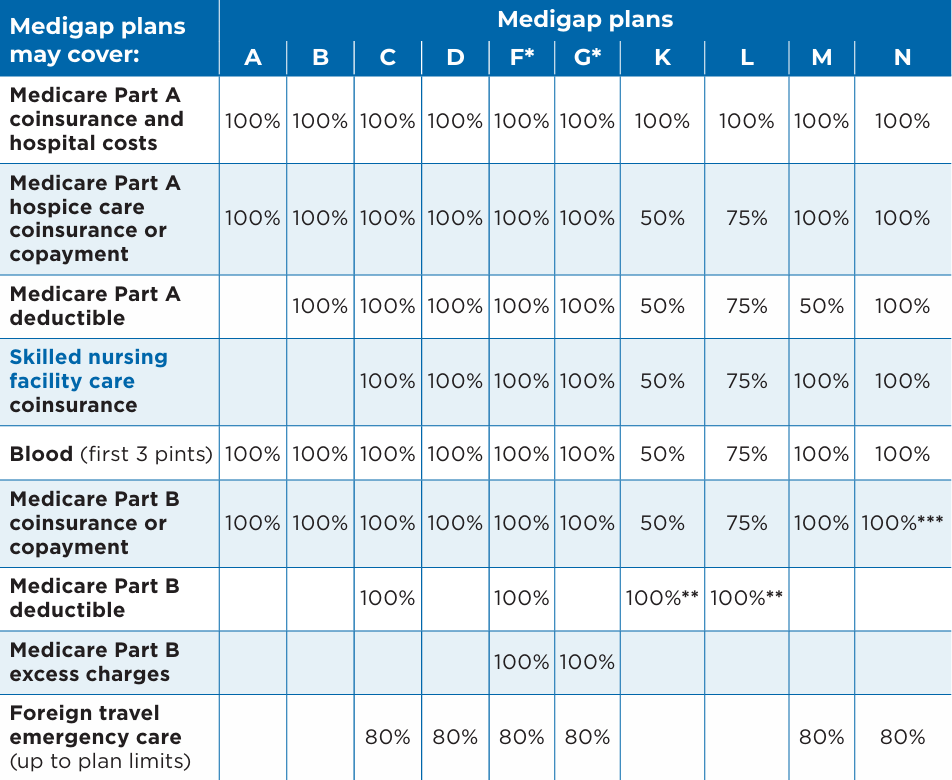
* Plans F and G also offer a high-deductible plan in some states. You must pay for Medicare-covered costs (coinsurance, copayments, and deductibles) up to the deductible amount of $3,050 in 2027 before your policy pays anything. (You can’t buy Plans C and F if you were new to Medicare on or after January 1, 2020.)
** For Plans K and L, after you meet your annual out-of-pocket limit ($8,360 for Plan K and $4,180 for Plan L in 2027) and your annual Medicare Part B deductible, the Medigap plan pays 100% of covered services for the rest of the calendar year.
*** Plan N pays 100% of the Part B coinsurance. You must pay a copayment of up to $20 for some office visits and up to a $50 copayment for emergency room visits that don’t result in an inpatient admission.
Can You Switch Medigap Plans During Open Enrollment?
Only in specific and limited circumstances do you have a guaranteed issue right to purchase a Medigap policy, which means that you might not be able to change Medigap policies during open enrollment. This means that the policy you purchase during your Medigap open enrollment period when you turn 65 may be the policy you have for the rest of your life.
The best time to buy a Medigap policy is during the Medigap open enrollment period, which begins on the first day of the month in which you are 65 or older and enrolled in Part B. If you do try to switch during the annual Medicare open enrollment period, you will likely be subject to medical underwriting. However, it does not hurt to weigh your options if you want to switch to Medigap from Medicare Advantage or switch Medigap plans.
In Massachusetts, where Medigap plans are called Core, Supplement 1, and Supplement 1A, residents have an annual opportunity to enroll in Medigap with guaranteed issue. This special rule is only available in Massachusetts, Maine, Connecticut, and New York; and in Massachusetts, it is available from February 1 to March 31 every year. Premiums for Medigap policies are community rated, which means that all members of each plan pay the same premiums. The premiums are not reflective of age.
Multiple states allow you to switch Medigap plans around your birthday with no medical underwriting, but only to plans with similar or less coverage.
In most states, you cannot switch Medigap plans after the Medigap open enrollment period without going through medical underwriting, which means that there is no guaranteed issue. There are a few exceptions to this, including if your Medicare Advantage plan discontinues coverage in your area, if you move to an area where your Medicare Advantage plan has no coverage, and if your Medigap or Medicare Advantage plan goes bankrupt.
Medicare Part D: How to Choose a Prescription Drug Plan
Medicare Part D is drug coverage provided and administered by private insurance companies. Part D covers brand-name and generic prescription medications and insulin. Each plan determines the medications it will cover and the costs associated with each medication.
Your first consideration when selecting a Part D plan is to see whether the plan covers the medications you need. You want to look at the plan’s coverage rules, specifically the quantity limit and need for prior authorization. Check out the plan’s network of preferred pharmacies because you will likely pay less for medications dispensed at a preferred pharmacy than you will at a standard network pharmacy.
Next, look at all the plan costs, including the monthly premiums, deductibles, copayments, and coinsurance. You will also want to understand whether the plan will require you to use generics, even if you know the brand name or specialty drug is more effective for you personally. Finally, check to see whether your doctor will need prior authorization from the insurance company before writing the prescription. This administrative requirement may disrupt your regular usage of a particular drug.
The Medicare Prescription Payment Plan is another option worth considering. This program allows people with Medicare Part D coverage to spread their out-of-pocket costs for covered prescriptions across monthly payments rather than paying the full amount at the pharmacy. While it doesn’t reduce the total cost of medications, it may make managing monthly expenses easier, particularly for those with higher prescription costs earlier in the year.
What Is the Part D Late Enrollment Penalty?
It is also important to note that even if you do not take medications, you should still consider enrolling in a Part D plan. If you do not, you will be assessed a late-enrollment penalty if/when you next sign up for a Part D plan. The penalty is a surcharge of 1% for every month that you were eligible but not covered.
How to Compare Medicare Plans During Open Enrollment
The best resource for comparing Medicare Advantage and Part D prescription drug plans is the Medicare Plan Finder. When using the tool, you’ll want to collect information related to the prescription drugs and the pharmacies that you use, because they drive a large portion of your out-of-pocket costs. You also need the dosage and frequency of ALL your prescriptions, because the more accurate you are with this information, the more precise the estimate of your out-of-pocket costs will be.
HeyMOE is a clean, easy-to-use application that analyzes Part D options for a $30 per year subscription fee. HeyMOE—Medicare Part D Open Enrollment Automatic Comparison Tool | Simplify Medicare Plans Today
You do not want to assume that the Medicare Advantage or Part D prescription drug plan that you had this year is going to be the best plan for next year. Any part of the plan, including the premiums, deductibles, copays, coinsurance, out-of-pocket limits, and prescription drug coverages, can change from year to year, so you have to do your homework and review your options each year.
It is important to remember that your health coverage preferences are unique and a plan that works for you may not work for someone else. You need to evaluate plans and coverage based on your own individual health, lifestyle, health care usage, preferences, and ability to pay premiums.
You may also want to look at each plan’s star ratings, which indicate the overall satisfaction of current and past plan participants.
Medicare Open Enrollment Checklist
- Read the Annual Notice of Change your plan mailed to you in September. It lists what is changing for 2027.
- List every prescription, with the dose and how often you take it.
- Confirm your doctors, hospitals, and pharmacies are still in network (and whether your pharmacy is “preferred”).
- Compare plans on the Medicare Plan Finder using your actual drug list, and look at total yearly cost, not just the premium.
- Check star ratings and whether your plan is still offered in your area.
- Make any changes by December 7, 2026.
How Your Income Affects Your Medicare Premiums (IRMAA)
Higher-income Medicare beneficiaries pay more for Part B and Part D through the Income-Related Monthly Adjustment Amount (IRMAA). Medicare generally looks at your income from two years earlier, so your 2027 premiums are based on your 2025 tax return. One-time events like a large Roth conversion, the sale of a business or rental property, or big capital gains can push you into a higher bracket for a year. If your income has dropped because of a life-changing event such as retirement, you can ask Social Security to use more recent income by filing Form SSA-44. Because IRMAA is tied to your tax return, it is worth planning for with your financial advisor and tax professional before you take large withdrawals or realize gains.
Frequently Asked Questions About Medicare Open Enrollment
When is Medicare open enrollment for 2027?
Medicare open enrollment for 2027 coverage runs from October 15 to December 7, 2026. Changes you make take effect January 1, 2027.
What happens if I miss Medicare open enrollment?
If you’re in a Medicare Advantage plan, you can make one change between January 1 and March 31, either switching to another Advantage plan or returning to Original Medicare. Otherwise, you generally have to wait until next fall unless you qualify for a Special Enrollment Period, such as after a move.
What is the Medicare Part D out-of-pocket maximum for 2027?
$2,400, up from $2,100 in 2026. The cap applies to qualifying out-of-pocket spending on covered Part D prescriptions, not monthly plan premiums or noncovered medications.
Do I have to do anything if I’m happy with my current plan?
No. If your plan is still offered, it will usually renew automatically. But premiums, covered drugs, and networks can change, so it’s worth reviewing your plan’s Annual Notice of Change before December 7.
Can I switch from Medicare Advantage to Medigap during open enrollment?
You can return to Original Medicare during open enrollment, but in most states Medigap insurers can review your health history and charge more or deny coverage. Massachusetts residents have an annual guaranteed-issue window from February 1 to March 31.
Get Help Choosing the Right Medicare Plan
We suggest you meet with a qualified Medicare representative along with your financial advisor to determine which Medicare plan is right for you. Free, unbiased Medicare counseling is also available through your State Health Insurance Assistance Program, called SHINE in Massachusetts and ADRC in New Hampshire.
Choosing the right Medicare supplement plan can be challenging, but you don’t have to navigate it alone. A financial advisor can provide you with resources for evaluating Medicare plans; help you stay informed about tax law changes; optimize your savings and investments; and avoid costly mistakes. If you need tailored guidance, our team is here to help. Reach out to us at (603) 589-8010 to integrate tax planning into your investment management and overall financial strategy.
Disclaimer:
The information provided is for educational and informational purposes only and does not constitute investment advice and it should not be relied on as such. It should not be considered a solicitation to buy or an offer to sell a security. It does not take into account any investor’s particular investment objectives, strategies, tax status or investment horizon. The views expressed in this commentary are subject to change based on market and other conditions. These documents may contain certain statements that may be deemed forward-looking statements. Please note that any such statements are not guarantees of any future performance and actual results or developments may differ materially from those projected. Any projections, market outlooks, or estimates are based upon certain assumptions and should not be construed as indicative of actual events that will occur.
All information has been obtained from sources believed to be reliable, but its accuracy is not guaranteed. There is no representation or warranty as to the current accuracy, reliability or completeness of, nor liability for, decisions based on such information and it should not be relied on as such.
Milestone Financial Planning, LLC (“Milestone”) is a fee-only financial planning firm and registered investment advisor headquartered in Bedford, NH. Registration does not imply a certain level of skill or training. Milestone works with clients on an ongoing, long-term basis, providing financial planning, tax planning, retirement planning, and investment management services. Fees are based on assets under management and may include a financial planning fee. Milestone receives no commissions or referral fees and, as a fiduciary, is required to act in clients’ best interests. Advisory services are offered only where Milestone and its representatives are properly licensed or exempt from licensure. More information, including fees and principal risks, is available in Milestone’s Form ADV Part 2A. For help with your investments or financial planning, contact one of our fee-only advisors.