If your income exceeds the limits for contributing directly to a Roth IRA, you may still have a path to building tax-free retirement income.
A Backdoor Roth IRA is a strategy that allows higher-income individuals to access Roth benefits by contributing to a traditional IRA and converting those funds into a Roth IRA. When used correctly, it can be a highly effective way to improve long-term tax efficiency.
Understanding how the strategy works, when it makes sense, and how it fits into your broader financial plan is key to using it effectively.
What Is a Backdoor Roth IRA?
A Backdoor Roth IRA is not a specific type of account, but a strategy used to bypass Roth IRA income limits.
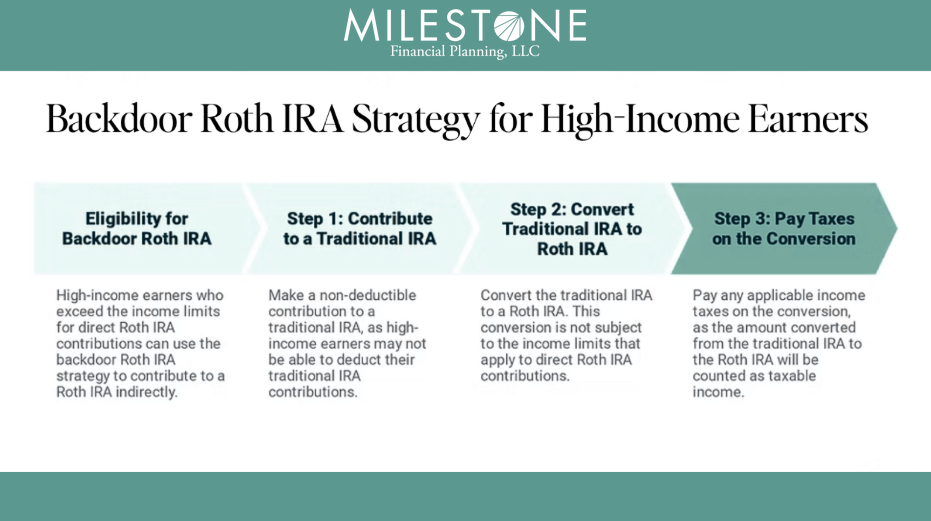
The process involves two steps:
- Making a non-deductible contribution to a traditional IRA
- Converting those funds into a Roth IRA
Because traditional IRA contributions do not have income limits, this strategy allows high-income earners to still benefit from tax-free growth and qualified withdrawals.
How Does a Backdoor Roth IRA Work?
Step 1: Make an After-Tax Contribution
To start, you must contribute after-tax dollars to a traditional IRA. If you (or your spouse) are covered by a workplace retirement plan and your income is above the deduction limits, the contribution typically won’t be deductible (aka after-tax dollars).
Step 2: Convert to a Roth IRA
You then convert the funds you contributed into a Roth IRA. If done correctly and with minimal delay, the tax impact of the conversion may be limited.
The Pro-Rata Rule
The pro-rata rule is one of the most important factors in determining whether a Backdoor Roth IRA is effective.
If you have existing pre-tax IRA balances, the IRS requires that conversions be treated proportionately across all traditional, traditional SEP, and traditional SIMPLE IRAs as of December 31.
Example:
- $90,000 pre-tax IRA balance
- $7,500 after-tax contribution
- Total IRA balance: $97,500
If you convert $7,500 to a Roth IRA in the above scenario, only about 7.7% (roughly $600) of that conversion would be tax-free, assuming there are no other relevant IRA balances, distributions, or transactions to affect the calculation. The remaining % of the conversion (roughly $6,900) would generally be taxable as ordinary income.
Existing pre-tax IRA balances can significantly reduce the tax efficiency of a Backdoor Roth IRA.
When Does a Backdoor Roth IRA Make Sense?
1. You have earned income, such a W-2 income or net profits from a business reported on Schedule C
2. You exceed Roth IRA income limits
This is the primary reason investors explore the Backdoor Roth strategy. However, see #4.
3. You expect higher taxes in the future
Paying taxes now to move funds into a Roth account may reduce total lifetime tax exposure.
4. You have little or no pre-tax IRA balances
This helps limit the impact of the pro-rata rule and makes the strategy more efficient.
5. You want tax diversification
Having a mix of tax-deferred, taxable, and tax-free accounts creates flexibility when managing retirement income.
Important Considerations Before Using a Backdoor Roth
- You must track after-tax contributions using IRS Form 8606
- Timing matters, converting quickly may reduce taxable gains
- Large IRA balances can reduce effectiveness
- The strategy should align with your overall tax plan
How This Fits Into a Broader Roth Strategy
Backdoor Roth IRAs are often used alongside other tax strategies.
For individuals evaluating when a Roth conversion makes sense, understanding how these strategies work together is important.
For those with access to certain employer plans, a Mega Backdoor Roth may provide an opportunity to contribute even more toward tax-free growth.
Final Thoughts
A Backdoor Roth IRA can be a valuable strategy for high-income individuals looking to build tax-free retirement income. When implemented thoughtfully, it provides a path to access Roth benefits that would otherwise be unavailable.
However, the effectiveness of the strategy depends on the details. Factors like existing IRA balances, tax timing, and how the conversion is executed all play a meaningful role in the outcome.
In many cases, the Backdoor Roth is most effective when it is part of a broader plan. A plan that considers your current tax situation, future income, and overall retirement goals rather than treating each decision separately.
Find Out If a Backdoor Roth IRA Makes Sense for You
A Backdoor Roth IRA can either be an efficient strategy, or an unnecessarily costly one if key factors are overlooked.
The difference comes down to planning.
At Milestone Financial Planning, we help you:
- Evaluate whether a Backdoor Roth strategy fits your situation
- Understand the tax impact before making a move
- Align Roth strategies with your long-term retirement plan
- Integrate conversions and contributions into a multi-year strategy
Start a conversation to see how a Backdoor Roth IRA could fit into your financial plan.
Frequently Asked Questions About Backdoor Roth IRAs
Is a backdoor Roth IRA allowed by the IRS?
The strategy is widely used, and Congress acknowledged it in the conference report for the 2017 Tax Cuts and Jobs Act. Tax law can change, though, and the details depend on your situation, so it’s worth reviewing with a tax professional before you start.
Do 401(k) balances count toward the pro-rata rule?
No. Balances in employer plans, such as a 401(k) or 403(b), are not included in the calculation, and neither are Roth IRAs. Some people roll pre-tax IRA money into their current employer’s plan to reduce the pro-rata impact, if the plan accepts incoming rollovers. That move has its own tradeoffs to weigh first.
What is the deadline for a backdoor Roth IRA?
You can make a traditional IRA contribution for a given tax year up to that year’s tax filing deadline, typically April 15 of the following year (not including extensions). The conversion, however, is taxed in the calendar year it happens, and the pro-rata rule uses your IRA balances as of December 31 of that year.
Can I undo a backdoor Roth conversion?
No. Since 2018, a Roth conversion can’t be recharacterized back to a traditional IRA. Once you convert, the decision is permanent, which is one reason to run the numbers before acting.
What’s the difference between a backdoor Roth and a mega backdoor Roth?
A backdoor Roth runs through a traditional IRA and is capped at the IRA contribution limit. A mega backdoor Roth uses after-tax contributions inside an employer plan, such as a 401(k), which are then converted to Roth. It’s only available if your plan allows after-tax contributions plus in-plan conversions or in-service withdrawals, and it can allow much larger amounts.
Disclaimer:
The information provided is for educational and informational purposes only and does not constitute investment advice and it should not be relied on as such. It should not be considered a solicitation to buy or an offer to sell a security. It does not take into account any investor’s particular investment objectives, strategies, tax status or investment horizon. The views expressed in this commentary are subject to change based on market and other conditions. These documents may contain certain statements that may be deemed forward-looking statements. Please note that any such statements are not guarantees of any future performance and actual results or developments may differ materially from those projected. Any projections, market outlooks, or estimates are based upon certain assumptions and should not be construed as indicative of actual events that will occur.
All information has been obtained from sources believed to be reliable, but its accuracy is not guaranteed. There is no representation or warranty as to the current accuracy, reliability or completeness of, nor liability for, decisions based on such information and it should not be relied on as such.
Milestone Financial Planning, LLC (“Milestone”) is a fee-only financial planning firm and registered investment advisor headquartered in Bedford, NH. Registration does not imply a certain level of skill or training. Milestone works with clients on an ongoing, long-term basis, providing financial planning, tax planning, retirement planning, and investment management services. Fees are based on assets under management and may include a financial planning fee. Milestone receives no commissions or referral fees and, as a fiduciary, is required to act in clients’ best interests. Advisory services are offered only where Milestone and its representatives are properly licensed or exempt from licensure. More information, including fees and principal risks, is available in Milestone’s Form ADV Part 2A. For help with your investments or financial planning, contact one of our fee-only advisors.