If you are wondering when a Roth conversion makes sense, it starts with understanding how Roth IRAs work and how they fit into your overall tax strategy. A Roth IRA allows you to contribute after-tax dollars, invest for long-term growth, and withdraw qualified distributions tax-free in retirement.
For many individuals, Roth IRAs and Roth conversions are key tools in building a more tax-efficient retirement strategy and gaining greater control over future taxes.
What is a Roth IRA?
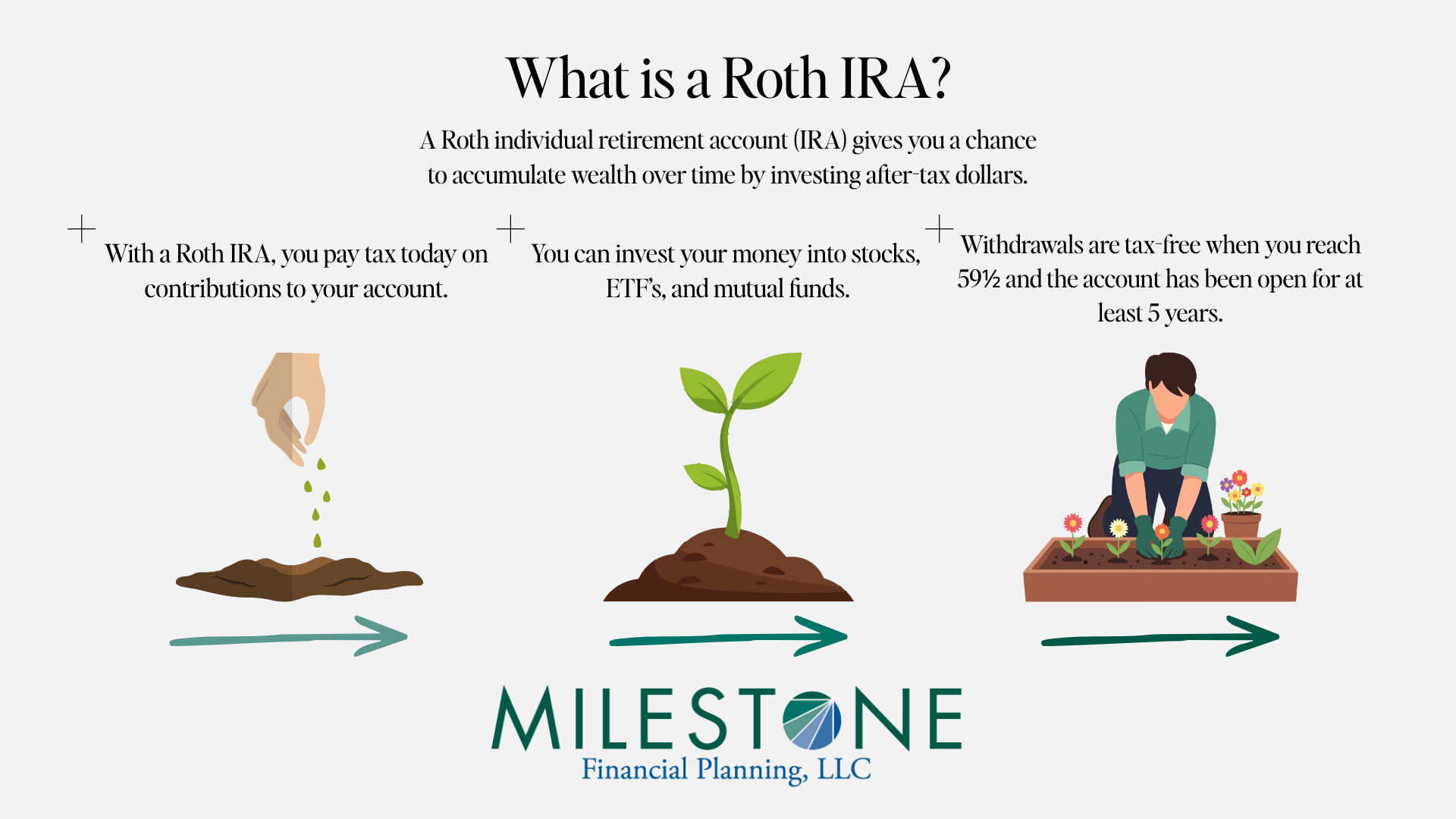
A Roth IRA is a tax-advantaged retirement account funded with money you’ve already paid taxes on. Once invested, your money can grow over time, and qualified withdrawals in retirement are completely tax-free.
You can invest in a variety of assets inside a Roth IRA, including stocks, bonds, mutual funds, and ETFs.
Roth IRA Rules You Need to Know:
2026 Contribution Limits:
- You can contribute up to $7,500 per year
- $1,100 additionally if you are age 50 or older
These limits apply across all IRA accounts (traditional and Roth) combined and are an important part of maintaining a consistent retirement savings plan.
2026 Income Limits (modified adjusted gross income):
| Filing Status | Full Contribution | Partial Contribution | Not Eligible |
|---|---|---|---|
| Single | Under $153,000 | $153,000 – $168,000 | $168,000+ |
| Married Filing Jointly | Under $242,000 | $242,000 – $252,000 | $252,000+ |
Eligibility to contribute to a Roth IRA is based on your modified adjusted gross income (MAGI). Your tax return must report at least the contribution amount in earned income in order to contribute the maximum, and if your income is too high, your contribution is disallowed:
Single Filers (2026)
- Full contribution: Less than $153,000
- Partial contribution: $153,000–$168,000
- Not eligible: $168,000 or higher
Married Filing Jointly (2026)
- Full contribution: Less than $242,000
- Partial contribution: $242,000–$252,000
- Not eligible: $252,000 or higher
Even if your income exceeds these limits, there are still planning strategies that may allow you to benefit from Roth accounts.
What if I earn too much?
If your income is above the contribution limits, there are still several strategies that allow you to access the benefits of a Roth IRA:
- Contributing to a Roth 401(k) through your employer
- Using a Backdoor Roth IRA strategy by making a non-deductible traditional IRA contribution and converting it to a Roth IRA
- Utilizing a Mega Backdoor Roth IRA strategy, if your employer plan allows after-tax 401(k) contributions and in-service conversions
- Completing a Roth conversion
It is important to understand that strategies like the Backdoor Roth IRA are subject to the IRS pro-rata rule, which can impact the amount of taxes owed when converting funds. This is especially relevant for individuals with existing pre-tax IRA balances, as it may reduce the effectiveness of the strategy.
What are qualified Roth IRA distributions?
Roth IRAs provide flexibility, but there are key rules to follow:
- Contributions can be withdrawn anytime without taxes or penalties
- You can withdraw earnings tax-free if:
- You have had any Roth IRA for at least 5 years (a contribution made April 15, 2027 for 2026 counts as starting the five year clock 1/1/2026) and
- You have a qualifying event, such as reaching age 59 ½, death, disability or a first-time home purchase (the latter capped at $10,000 lifetime).
- Roth conversions for those under age 59 ½ have their own five year rule. Withdrawing converted funds withing five years of the conversion may trigger penalty on the conversion amount.
Roth IRA versus traditional IRA
The biggest difference between a Roth IRA and a traditional IRA is when you pay taxes:
- Roth IRA: You pay taxes now, but qualified withdrawals in retirement are tax-free
- Traditional IRA: You may get a tax break today, but withdrawals are taxed later
Whether the Roth or Traditional is better depends on whether your tax rate is higher now or later, which is exactly what a Roth conversion strategy is meant to address.
When Should You Do a Roth Conversion?
A Roth conversion is when you move money from a pre-tax retirement account (like a traditional IRA or 401(k)) into a Roth IRA. You pay taxes on the converted amount now, but future growth and withdrawals are tax-free. This strategy is not about evaluating whether or not Roth assets are valuable, but it’s about whether now is the right time to pay the taxes.
When a Roth conversion most often makes sense:
1. You expect your tax rate to be higher in the future
If tax rates rise or your income grows significantly in retirement, paying taxes today at a lower rate can reduce your total lifetime tax bill.
2. You are in a temporarily lower-income year
Career transitions, early retirement, or a year with business losses can create a window where your tax rate is unusually low compared to other years, a time worth evaluating conversions.
3. You want to reduce future required minimum distributions (RMDs)
In general, traditional IRAs and 401(k)s require you to take withdrawals starting at age 73 (75 if you were born after 12/31/1959), whether you need the money or not. Those withdrawals are taxable. Converting to a Roth should reduce your “traditional pre-tax” balance. Therefore, your future RMDs should also be reduced, which can give you more control over your taxable income later in life, once your RMDs begin.
4. You want more flexibility in retirement
Tax-free accounts give you options. Having both taxable and tax-free income sources allows you to manage your tax bracket strategically rather than being forced into a single income stream.
5. You are focused on legacy planning
Roth IRAs have no RMDs during your lifetime, allowing the account to continue growing for longer. Inherited Roth IRA distributions are generally tax-free for beneficiaries, making Roth assets a useful tool for transferring wealth.
Example: How a Roth Conversion Can Reduce Taxes
Consider a hypothetical couple who both retire at 62. They have $800,000 in a traditional IRA, $25,000 in interest, $40,000 in dividends (half of them qualified) and no other income yet. Social Security does not start until 67.
For those five years, they are in a lower tax bracket than they expect to be at age 75 once RMDs and Social Security begin. If they convert $50K from IRA to Roth each year, they should reduce their IRA balance from $800K to $550K over the next 5 years (+/- market returns); reduce their future RMD amount; protect against higher tax rates when eventually single; provide cash flow flexibility with a now tax-free pool of money; potentially pay taxes on a portion of the distributions at a lower tax rate than once they are collecting Social Security and RMDs. This also assumes the taxes are paid with money outside the IRA/Roth accounts.
Depending on future tax rates, investment returns, and how long each spouse lives, this approach may lower their total lifetime taxes, while also giving them a growing pool of tax-free income to draw from.
This hypothetical is for illustration only and does not represent an actual client. It assumes 2026 federal tax law, married filing jointly, the standard deduction, and no state income tax. Individual results will vary. Roth conversions aren’t right for everyone; consult your tax advisor before converting.
It can work because of the income gap between early retirement and the start of RMDs.
We work with many clients in their early 60s who have recently retired and are in a temporarily lower tax bracket. By converting a portion of their IRA each year before Social Security begins, they may be able to take advantage of lower tax rates and reduce future required minimum distributions.
Important considerations before converting
A Roth conversion is not always the right move and should be carefully planned:
- You will owe federal income taxes upfront on the converted amount. many states, including MA and ME, also tax Roth conversions
- Large conversions can push you into a higher tax bracket, sometimes eliminating the benefit
- Spreading conversions over multiple years can be more effective than converting a large amount at once
- Income in or after the year you turn age 63 can increase your Medicare premiums for the tax year 2 years in the future
- Extra income can reduce or eliminate the ACA premium tax credit, if applicable
The strategy works best when you can pay the Roth conversion tax bill with non-IRA funds. This allows the full converted amount to stay invested and growing.
Create a legacy
Roth IRAs do not require required minimum distributions (RMDs) during the original account owner’s lifetime. This allows the account to continue growing tax-free for a longer period, which can increase the value passed on to beneficiaries.
For heirs, inherited Roth IRA distributions are generally tax-free, provided certain rules are met, making Roth assets a valuable tool for transferring wealth across generations.
Start Building a Tax-Efficient Retirement Strategy
Understanding when a Roth conversion makes sense is the first step. The real value comes from applying the strategy in a way that aligns with your income, tax situation, and long-term retirement goals.
At Milestone Financial Planning, we help clients evaluate whether a conversion makes sense this year, how much to convert, and how it fits into a multi-year tax plan.
Start a conversation with a financial advisor to see how a Roth conversion strategy could impact your retirement plan.
Frequently Asked Questions About Roth Conversions
Is a Roth conversion taxable?
Yes. The amount you convert from a pre-tax account is treated as ordinary income in the year of the conversion. This is why timing and tax bracket management are critical when deciding how much to convert.
How much should I convert to a Roth IRA?
The amount depends on your current tax bracket and long-term strategy. Many individuals aim to “fill up” their current tax bracket without pushing into a higher one, often spreading conversions over multiple years. Nowadays you have to be careful with that strategy, as the interaction with other parts of tax law can result in paying a tax rate that is higher than your marginal rate on the extra income.
Should I convert it all at once or over multiple years?
In most cases, spreading conversions over multiple years can be more effective. Converting too much in one year can push you into a higher tax bracket and reduce the overall benefit of the strategy.
Does a Roth conversion affect Social Security or Medicare?
Yes, it can. Since a Roth conversion increases your taxable income in the year it is completed, it may impact the taxation of Social Security benefits or increase Medicare premiums (IRMAA). Planning ahead helps manage these effects.
Can I undo a Roth conversion?
No. Roth conversions can no longer be reversed, so it’s important to carefully evaluate the strategy before executing it.
Disclaimer:
The information provided is for educational and informational purposes only and does not constitute investment advice and it should not be relied on as such. It should not be considered a solicitation to buy or an offer to sell a security. It does not take into account any investor’s particular investment objectives, strategies, tax status or investment horizon. The views expressed in this commentary are subject to change based on market and other conditions. These documents may contain certain statements that may be deemed forward-looking statements. Please note that any such statements are not guarantees of any future performance and actual results or developments may differ materially from those projected. Any projections, market outlooks, or estimates are based upon certain assumptions and should not be construed as indicative of actual events that will occur.
All information has been obtained from sources believed to be reliable, but its accuracy is not guaranteed. There is no representation or warranty as to the current accuracy, reliability or completeness of, nor liability for, decisions based on such information and it should not be relied on as such.
Milestone Financial Planning, LLC (“Milestone”) is a fee-only financial planning firm and registered investment advisor headquartered in Bedford, NH. Registration does not imply a certain level of skill or training. Milestone works with clients on an ongoing, long-term basis, providing financial planning, tax planning, retirement planning, and investment management services. Fees are based on assets under management and may include a financial planning fee. Milestone receives no commissions or referral fees and, as a fiduciary, is required to act in clients’ best interests. Advisory services are offered only where Milestone and its representatives are properly licensed or exempt from licensure. More information, including fees and principal risks, is available in Milestone’s Form ADV Part 2A. For help with your investments or financial planning, contact one of our fee-only advisors.