For individuals who have already maximized their own retirement contributions ($24,500 for 2026; $32,500 if age 50 or over and $35,750 if age 60-63), a Mega Backdoor Roth IRA can provide a way to contribute significantly more to Roth accounts to build tax-free wealth.
While a standard Backdoor Roth IRA is limited by IRA contribution caps, the Mega Backdoor strategy allows significantly larger contributions. However, that’s only if your employer’s 401(k) plan supports it.
Understanding how it works and whether it applies to your situation is essential before implementing this strategy.
What Is a Mega Backdoor Roth IRA?
A Mega Backdoor Roth IRA is a strategy that allows you to contribute after-tax dollars to a 401(k) and then convert those funds into a Roth account.
Unlike a standard IRA-based strategy, this approach uses employer-sponsored retirement plans to significantly increase how much can be moved into tax-free accounts.
How Does a Mega Backdoor Roth IRA Work?
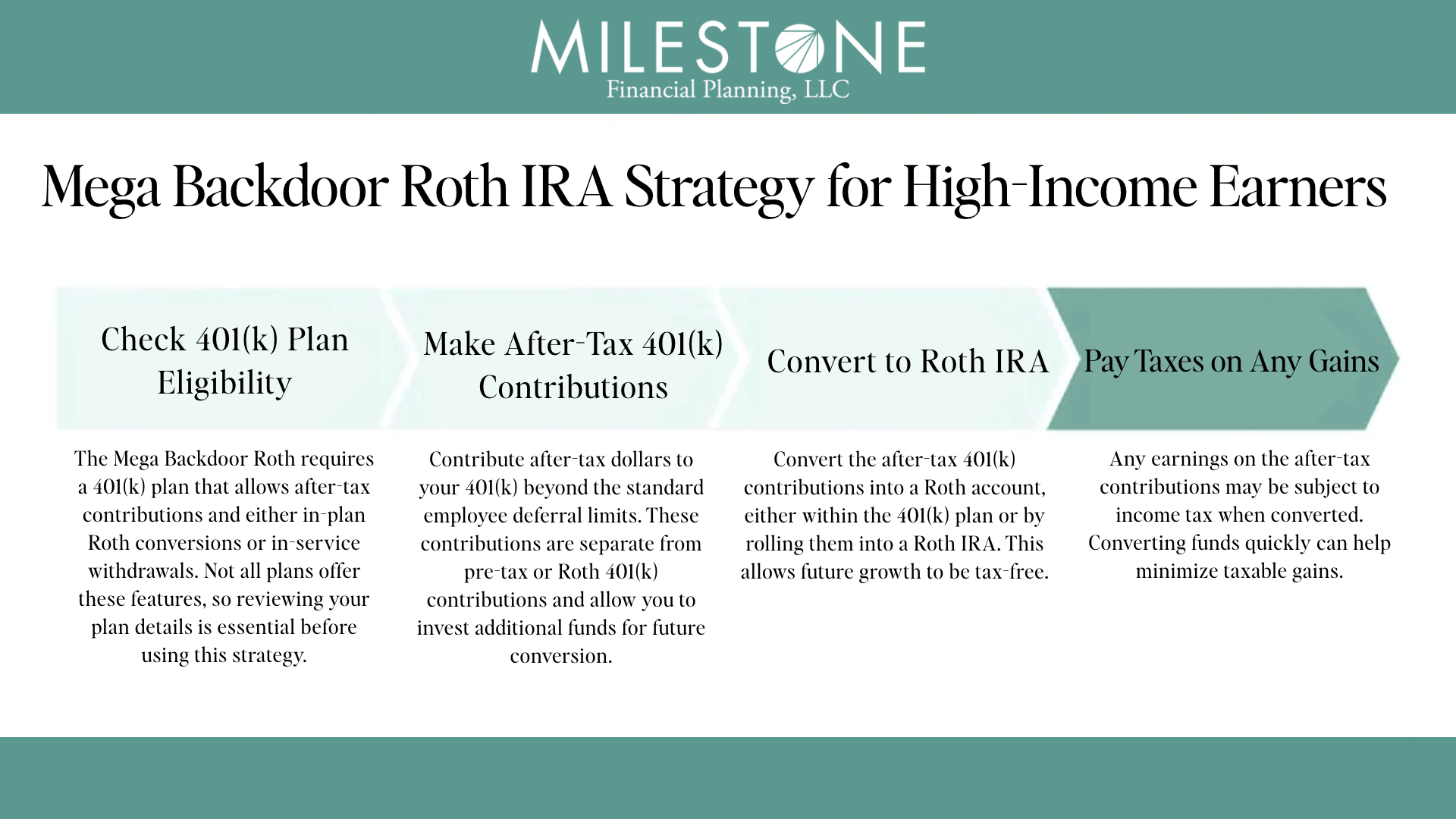
To use this strategy, your 401(k) plan must allow:
- After-tax contributions beyond standard deferral limits
- In-service withdrawals or in-plan Roth conversions
Step-by-Step Process
- Maximize your 401(k) deferrals
- Contribute after-tax funds to your 401(k) up to your plan’s contribution limits
- When allowed, convert those funds into:
- A Roth 401(k), or
- A Roth IRA
Why the Mega Backdoor Roth Is Powerful
The primary advantage is the significantly higher contribution capacity.
In 2026, the IRS allows the lesser of 100% of compensation or $72,000 in total 401(k) contributions, including employee, employer, and after-tax contributions. Those 50 and older may be able to add catch-up contributions on top of that limit. How much of that room you can fill with after-tax dollars depends on your plan rules. Starting in 2026, if you earned more than $150,000 in the prior year in box 3 of your W-2, your catch-up contributions must be designated as Roth.
This allows investors to move substantially more money into a tax-free environment compared to traditional IRA strategies.
Who Should Use a Mega Backdoor Roth?
1. High-income earners
Individuals already maxing out:
- Employer retirement contributions (401ks, 403bs, etc.)
- Traditional or Roth IRAs
2. Professionals with strong cash flow
Because contributions are made with after-tax dollars, this strategy requires excess income.
3. Individuals with a qualifying employer plan
Not all plans allow this strategy, so reviewing your plan details is critical.
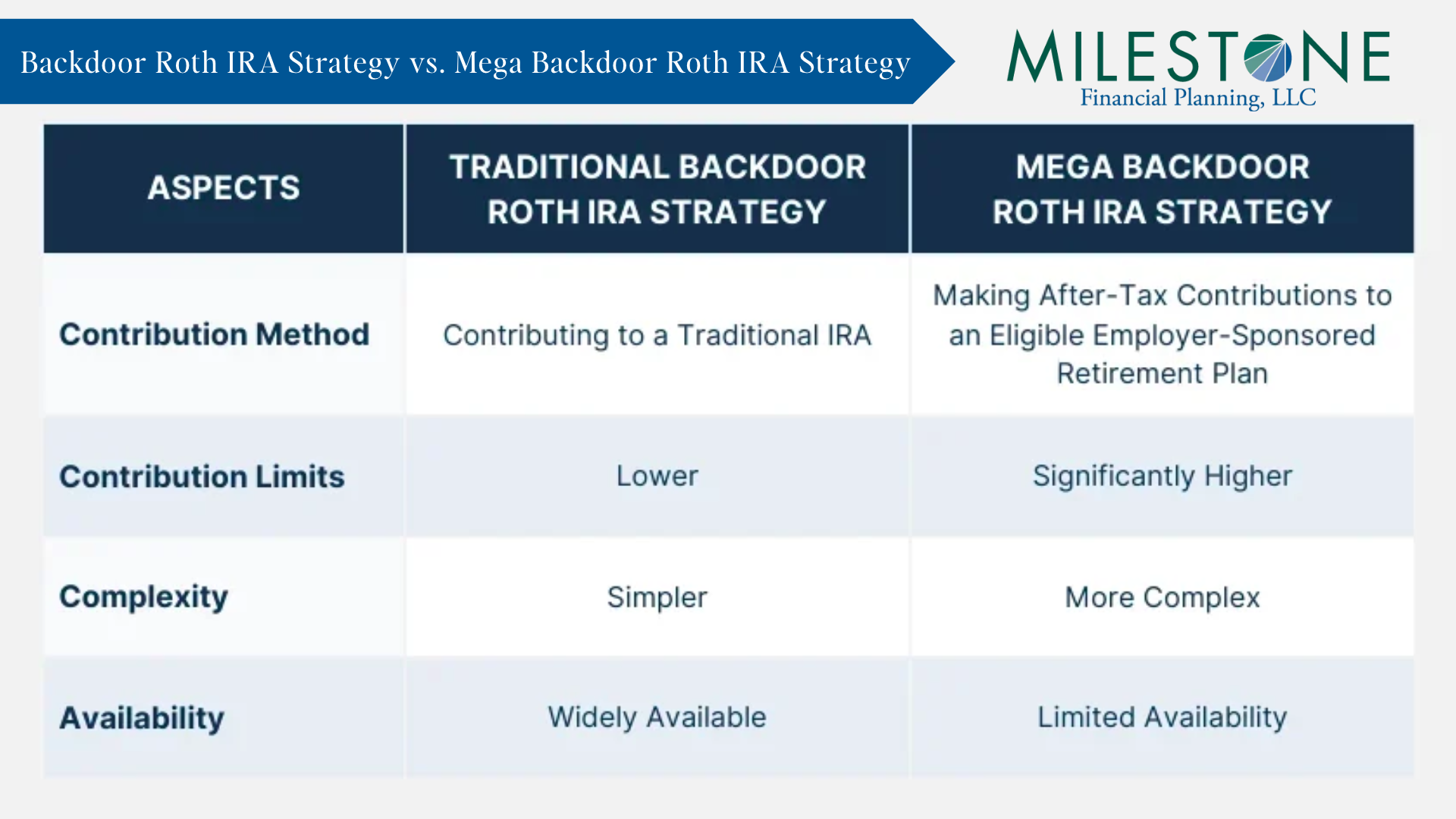
Mega Backdoor Roth vs Backdoor Roth IRA
How This Fits Into a Broader Roth Strategy
The Mega Backdoor Roth is often used alongside:
- Backdoor Roth IRA strategies
- Roth conversion planning
Together, these strategies can help build a more tax-efficient retirement plan over time.
Important Considerations
- Employer plan rules vary significantly
- Timing of conversions may impact tax outcomes
- Strategy requires coordination across accounts
- Typically, most effective when planned over multiple years
- No tax deduction on contributions
- Earnings on after-tax contributions are taxable when converted
- Highly compensated employees may be limited on how much they can contribute
- This strategy ties up a significant amount of cash
Final Thoughts
A Mega Backdoor Roth IRA can be one of the most powerful tools available for building tax-free retirement assets, particularly for high-income individuals with access to the right employer plan.
However, with that opportunity comes added complexity. Contribution limits, plan rules, and execution timing all play a role in determining how effective the strategy will be.
For many investors, the Mega Backdoor Roth works best as part of a broader strategy that includes traditional contributions, Backdoor Roth IRAs, and well-timed Roth conversions.
The tax-free nature of Roth IRAs or Roth 401(k)s applies to qualified distributions only, so there are additional rules to follow.
When these strategies are aligned, the long-term impact can be substantial.
Find Out If a Mega Backdoor Roth IRA Is Right for You
A Mega Backdoor Roth strategy can unlock significant long-term tax benefits, but only if your plan allows it and it’s implemented correctly.
At Milestone Financial Planning, we help you:
- Review your 401(k) plan to determine if the strategy is available
- Identify how much you can contribute beyond standard limits
- Coordinate conversions to manage taxes effectively
- Integrate Mega Backdoor contributions into a long-term plan
- Start a conversation to explore how a Mega Backdoor Roth IRA could fit into your overall retirement strategy.
Frequently Asked Questions
What is a Mega Backdoor Roth IRA?
It’s a strategy for contributing more than the normal employee contribution limits into your 401(k) (after tax) and then soon after converting it to a Roth account, either a Roth 401(k) or Roth IRA.
How much can I contribute to a Mega Backdoor Roth in 2026?
In 2026, the IRS caps total 401(k) contributions from all sources at the lesser of 100% of compensation or $72,000. That total includes your own deferrals, your employer’s contributions, and after-tax contributions. Your after-tax room is whatever is left under that cap. For example, if you defer $24,500 and your employer contributes $10,000, you could contribute up to $37,500 after-tax, if your plan allows that much. Catch-up contributions for those 50 and older are on top of the $72,000 limit.
Starting in 2026, if you earned more than $150,000 in the prior year in box 3 of your W-2, your catch-up contributions must be designated as Roth.
Are there income limits for a Mega Backdoor Roth?
No IRS income limit applies to after-tax 401(k) contributions or Roth conversions. That is why high earners who can’t contribute directly to a Roth IRA often consider the Mega Backdoor Roth. It can also work for people with large pretax IRA balances. Those balances can make a regular Backdoor Roth IRA partly taxable under the pro-rata rule, but they don’t affect a Mega Backdoor Roth, because after-tax 401(k) money is tracked separately from your IRAs.
Do I owe taxes when I convert after-tax contributions to Roth?
Your after-tax contributions are not taxed again when converted. Any earnings on those contributions before the conversion are taxable. Converting soon after each contribution keeps those earnings, and the tax on them, small. Some plans offer automatic conversions for this reason.
Should I convert to a Roth 401(k) or a Roth IRA?
It depends on what your plan allows and your goals. An in-plan conversion keeps the money in your Roth 401(k) and is often simpler. A rollover to a Roth IRA, done through an in-service withdrawal, may give you more investment choices and more flexibility on withdrawals, as Roth IRA withdrawal ordering rules allow you to take out contributions first. Some plans offer only one option.
How do I find out if my 401(k) plan allows a Mega Backdoor Roth?
Check your plan’s Summary Plan Description or ask your HR department or plan administrator. You need two features: the ability to make after-tax contributions beyond the standard deferral limit, and either in-plan Roth conversions or in-service withdrawals of after-tax money.
Can I do a Backdoor Roth IRA and a Mega Backdoor Roth in the same year?
Yes. They have separate limits, so many high earners use both. The two strategies can affect each other, though. For example, rolling pretax earnings into a traditional IRA can create taxes on a later Backdoor Roth IRA conversion under the pro-rata rule. Planning the order of steps matters.
Do I need a financial advisor to set up a Mega Backdoor Roth?
Not necessarily, but the details matter. Plan rules, contribution timing, conversion taxes, and how this fits with your other accounts can all affect the outcome. A financial planner can review your plan documents and help you decide whether the strategy makes sense for your situation.
Disclaimer:
The information provided is for educational and informational purposes only and does not constitute investment advice and it should not be relied on as such. It should not be considered a solicitation to buy or an offer to sell a security. It does not take into account any investor’s particular investment objectives, strategies, tax status or investment horizon. The views expressed in this commentary are subject to change based on market and other conditions. These documents may contain certain statements that may be deemed forward-looking statements. Please note that any such statements are not guarantees of any future performance and actual results or developments may differ materially from those projected. Any projections, market outlooks, or estimates are based upon certain assumptions and should not be construed as indicative of actual events that will occur.
All information has been obtained from sources believed to be reliable, but its accuracy is not guaranteed. There is no representation or warranty as to the current accuracy, reliability or completeness of, nor liability for, decisions based on such information and it should not be relied on as such.
Milestone Financial Planning, LLC (“Milestone”) is a fee-only financial planning firm and registered investment advisor headquartered in Bedford, NH. Registration does not imply a certain level of skill or training. Milestone works with clients on an ongoing, long-term basis, providing financial planning, tax planning, retirement planning, and investment management services. Fees are based on assets under management and may include a financial planning fee. Milestone receives no commissions or referral fees and, as a fiduciary, is required to act in clients’ best interests. Advisory services are offered only where Milestone and its representatives are properly licensed or exempt from licensure. More information, including fees and principal risks, is available in Milestone’s Form ADV Part 2A. For help with your investments or financial planning, contact one of our fee-only advisors.